Home › Design Assets › The Humble Administrator's Garden, Held Up by Negative Space
The Humble Administrator's Garden, Held Up by Negative Space
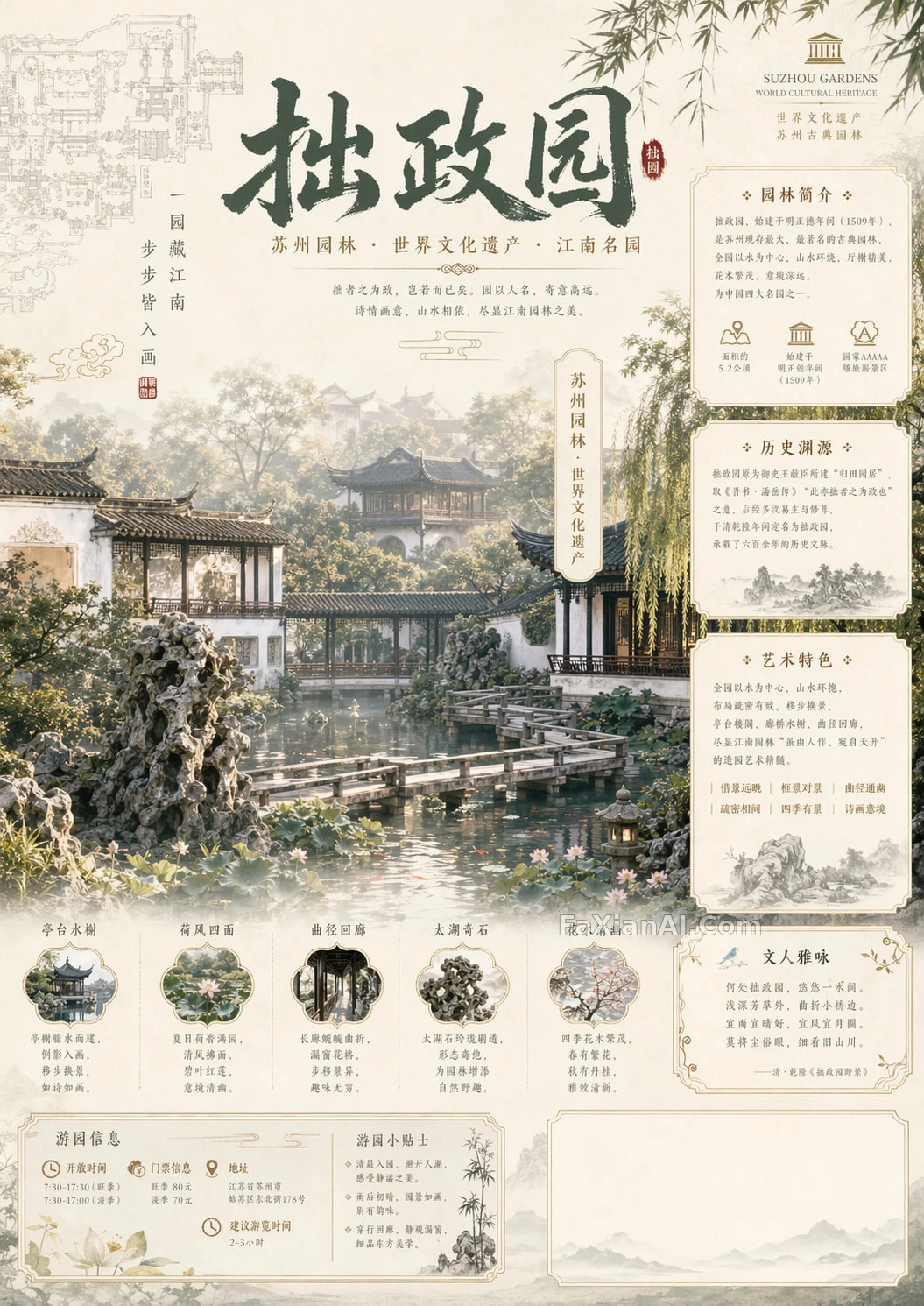
The problem is that Jiangnan gardens are too easy to overstuff — this version reins in the sheer amount of information with negative space.
✍️ The problem was never a lack of information, it's that too many modules scatter the eye — three columns plus a row of icons at the bottom is already the ceiling for information density; add one more block and something else has to go.
📋 Prompt Natural Language2532 characters
A vertical tourism poster with its theme locked to Suzhou's Humble Administrator's Garden, blending real garden photography, guofeng fine-brush painting, ink-wash freehand style, and a modern premium layout — the overall direction refined, dignified, and ornate without ever feeling cluttered, capturing the poetry, history, and Eastern aesthetic of a classical Jiangnan garden. The primary visual shows the garden's signature scenery: white walls and dark tile roofs, pavilions and towers, winding covered corridors, waterside pavilions and bridges, a lotus pond, Taihu rockery, bamboo-shadowed lattice windows, weeping willows leaning over the water, reflections on the surface, a thin morning mist — buildings receding layer by layer into the distance, lotus leaves and Taihu rocks building an exquisite foreground, evoking that classic Eastern sense of a scene changing with every step. The layout should divide the information into zones: at the top, a calligraphic main title reading '拙政园' (The Humble Administrator's Garden), with smaller text beside it reading 'Suzhou Gardens · UNESCO World Heritage Site · A Great Jiangnan Garden'; the middle section is the main visual display, spreading out the waterscape, pavilions, corridors, lotus pond, Taihu rocks, and weeping willows; the left side holds a delicate garden floor-plan line drawing, classical seals, and vertical lines of poetry, such as 'One garden holds all of Jiangnan, every step a painting'; the right side reserves an information column for modules like 'Garden Introduction,' 'Historical Origins,' and 'Artistic Features,' framed with a classical border and a rice-paper texture background; the bottom row lays out four to six small text-and-icon modules, using elegant icons to call out features such as the pavilions and waterside terraces, lotus breeze on all sides, winding paths and corridors, the wonder of Taihu rockery, tranquil flowers and trees, and the poetry of Jiangnan. The overall information density should stay high while the composition remains clean with a clear visual focus, giving it the texture of a tourism-brochure cover or a museum exhibition poster. The palette centers on teal-green, moon white, rice gold, pale ink grey, lotus-leaf green, and pale pink lotus-blossom tones, with morning light spilling across the eaves, water, and lotus leaves for a warm, luminous, premium feel; the text zones should be neatly arranged, carrying cultural depth, historical weight, and Eastern aesthetics befitting high-end promotional material.