
Three Angles in One Shot: What a Character Sheet Prompt Has to Nail Down
When a single image misses, you just run it again. A character sheet is different — three to twelve views land in one frame, and anything you failed to pin down ruins the whole sheet. The awkward part is that "the thing you must pin down" is not the same thing for every kind of sheet.
Turnarounds: Lock the Proportions, Not the Pose
A turnaround has exactly one job: keep the same character recognizable from every angle. The grey cat and brown mouse turnaround states it plainly — front, side, back and three-quarter views in one composition, with `proportions locked identical across every angle`. That clause is the foundation of the whole sheet. The identifying props — red collar, cream muzzle, amber eyes — then have to be named again at every angle, or the model quietly drops them on the back view.
What you should not lock is the pose. Lock the pose and you get one drawing rotated four times, which reads flat.
The Nezha turnaround shows a cheaper route: inherit the layout and panel divisions straight from a reference sheet, and let the prompt only say who to swap in. That works if you already have one sheet whose layout you like — get the frame right once, then treat it as a mold, which beats describing panel order from scratch every time.
Practice: a turnaround prompt should carry at least two repeated clauses — one locking proportions, one listing the identifying props.
Reference Boards: Density Comes From Zoning, Not From Cramming
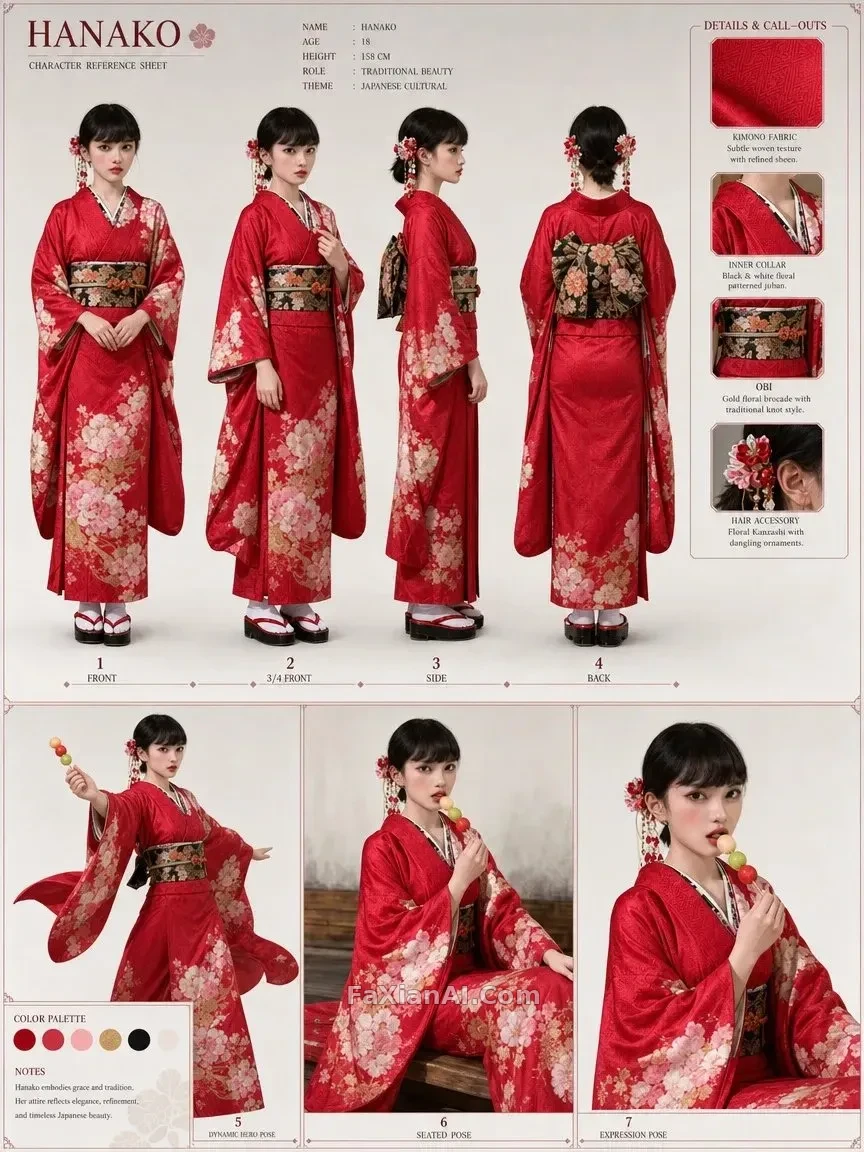
A sheet is more than views. It also carries a palette, hair detail, small pose studies. This Japanese-style reference sheet makes the point: collage density is not "fill every inch." Palette, poses and hair detail each need their own structural block, or the page collapses into a texture wall. It also carries a useful counter-example — the prompt asks for the face to stay blurred and anonymized, and the render draws it clearly in all seven panels. Prohibitive instructions like that are unreliable. If you actually need anonymity, get it from composition (back view, occlusion, crop), not from one sentence.
The watercolor-mixed-media travel coder board goes the other way: few elements, layered by brushwork density. Keep a real gap between the doodle-style figures and the breakdown sketches, or the whole page reads as one undifferentiated study.
Multi-Panel Grids: Separate the Constant From the Variables
Strictly speaking this isn't a character sheet, but it solves the same problem — one person across different setups.
The four-panel menswear mood grid holds exactly one constant: that sharp-jawed face. Outfit, pose, light and mood reset in every panel. What actually carries the readability is the lighting system — cool white, warm velvet, backlight, warm daylight, one per panel. Get the light right and the period signals in the clothing land with it.
The cyberpunk lemur hybrid exposes where hybrid designs usually fail: a tail or an extra limb with no functional explanation just hangs there as decoration. Give every non-human part a job and the design reads as credible instead of pasted on.
Storyboards and Infographics: Sequence Is the Skeleton
The twelve-panel cinematic storyboard looks like a design exercise but behaves like an infographic. A 4x3 grid, numbered panels, a bold title and bullets under each — what decides whether it works is narrative sequence. Color and titles are decoration. Twelve panels is already close to the readable ceiling, so write the sequence first and push the style words to the back.
The Shortcut That Starts From a Photo
The photo-to-turnaround version and the tokkofuku biker 3D sheet run the same idea in two directions: hand over a reference photo, let the model fill in the missing angles, and spend your words on the target finish instead. The second one also leaves a `gender` slot open, so one outfit spec can be flipped between a male and a female version — pulling variables out of the prose into explicit slots is far steadier than rewriting the whole prompt each time.
Practice: when starting from a photo, write "keep hair and outfit details consistent" as its own sentence. Don't expect the model to infer it from the reference.
---
If the more basic problem is that the same person looks different from scene to scene, the character consistency piece is the closer fit; for turning variable slots into proper fields, structured prompt writing has the full field design. More multi-view and character design work sits under the illustration category.