Home › Design Assets › Physics Laws Rendered as Luxury Instrument Posters
Physics Laws Rendered as Luxury Instrument Posters
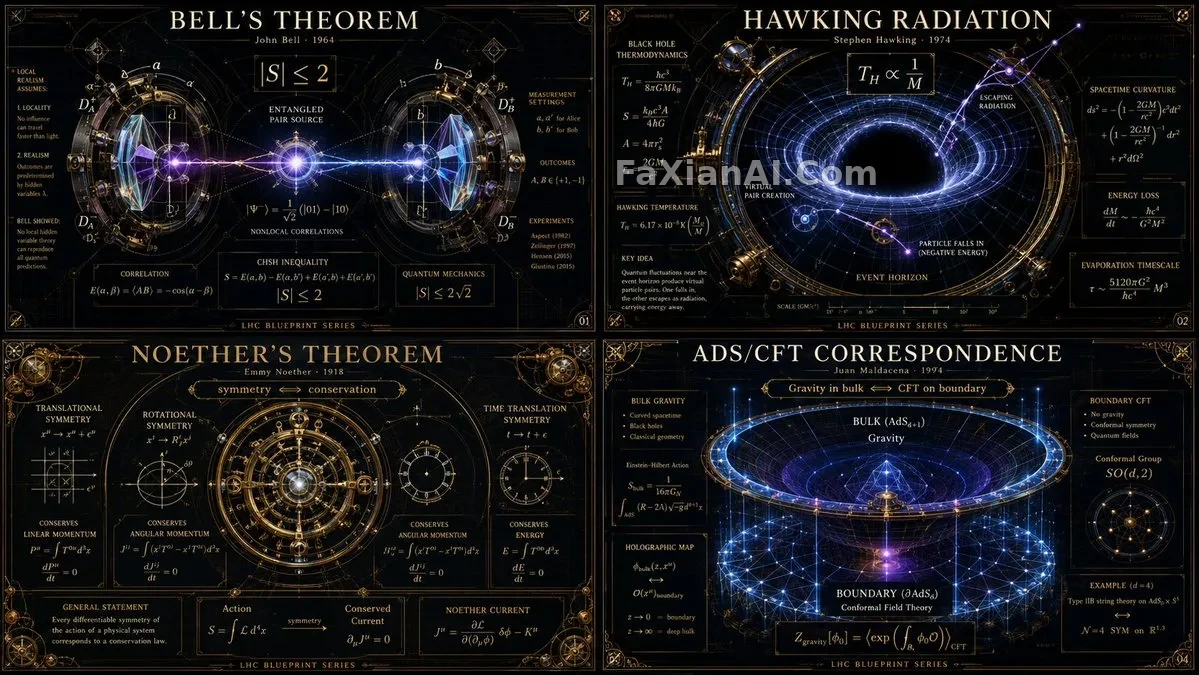
Whether the poster holds up comes down to how hard that ring of mirrored refraction reads — the glowing equations are just a bonus.
✍️ This all-over-glowing black poster looks great on screen, but CMYK printing can't hit that brightness — fine halftone dots just go gray, so if you actually print it, you need to bank some contrast headroom.
📋 Prompt Natural Language1975 characters
Design a 16:9 grid of luxury scientific infographic posters that give physical form to [topics: 4 distinct advanced physics theorems or paradoxes, e.g. Bell's theorem, Hawking radiation, string theory]. Draw the composition from Large Hadron Collider blueprints — hyper-complex radial symmetry, intersecting particle-beam rings, millimeter-precise drafting — set inside a deep-space-observatory atmosphere of pitch-black voids, glowing ultraviolet radiation, and high-contrast laser illumination. Layer in chalkboard-maximalist graphics: dense mathematical notation floating as glowing white vector lines. Finish every surface like a Victorian brass optical instrument — finely milled prisms, glass lenses, mirrored refraction planes. | Push the material further: let the equations solidify into glowing three-dimensional glass sculptures that bend light around themselves; weave the particle-collision tracks like fine gold thread through the dark background; and render each invisible physical law as a massive, tangible gravitational machine warping the poster's own grid. | Lay the whole thing out as a 2x2 grid of vertical luxury posters, one per theorem, each inventing its own magnificent scientific machine or optical diorama, exploding the layers to reveal quantum states, gravitational warping, equations, and subatomic scale — as if it were a classified schematic from a hyper-advanced, aesthetically obsessed civilization, making the invisible laws of physics breathtakingly visible. | Typography per poster: a large title naming the theorem or paradox, a subtitle naming the physicist and era, and microtext carrying the core equation or metric tensor as an explanatory blazon. | Composition: strict radial or gravitational-well symmetry, razor-sharp fine lines against deep voids. Lighting: harsh, clinical laser light hitting pure optical glass and vantablack surfaces. | Keep it museum-grade: no cartoon atoms, no clip-art planets, no messy chalkboard scrawl.