A Full Lighting Textbook Run Through a Nine-Grid
From ring light to split light to underlighting, nine setups laid side by side on one face so the shadow shapes and color-temperature shifts are unmistakable.
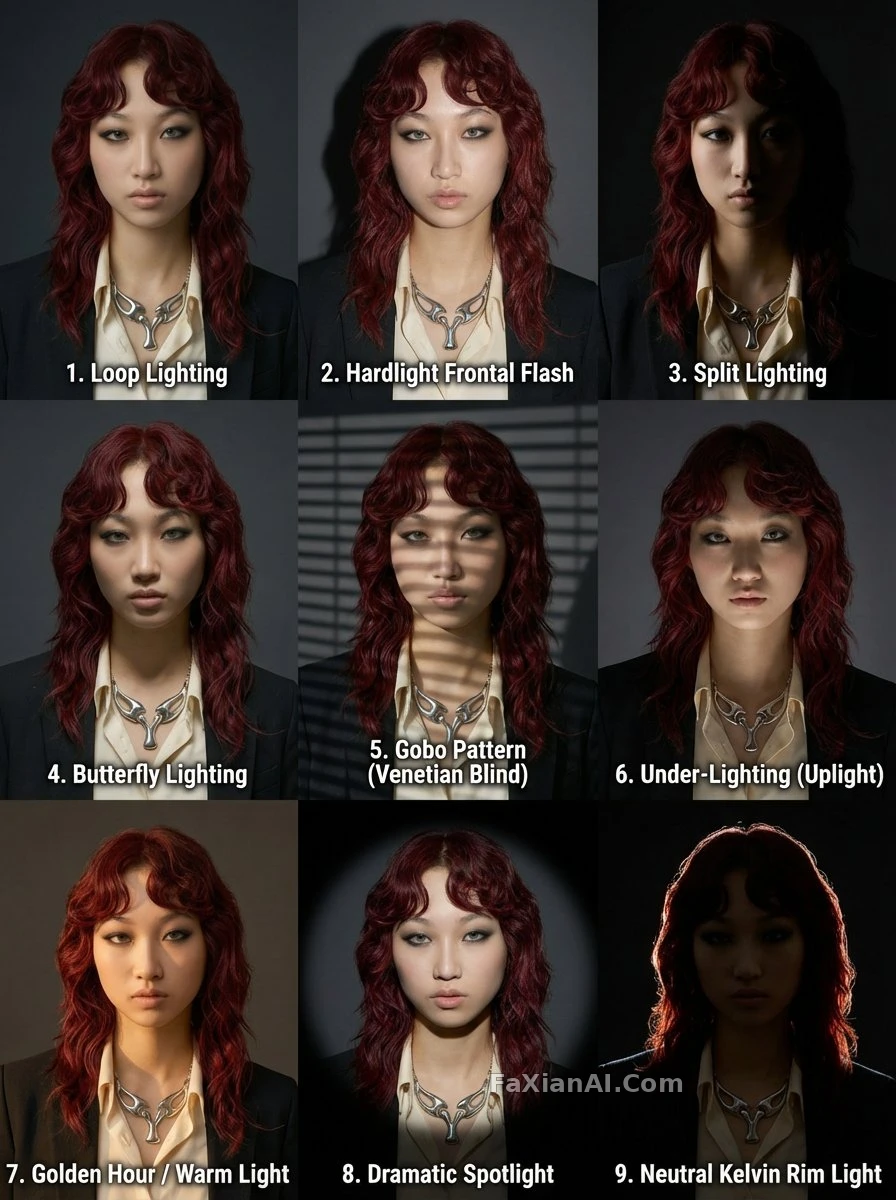
✍️ The difference between the nine setups comes down to shadow shape and color temperature — ring light leaves a small halo shadow, butterfly light leaves a little patch under the nose. Comparing them on the same face is the only way to actually see how much these details differ.
📋 Prompt Natural Language1397 characters
A 3x3 nine-grid composite on a dark gray background, each of the nine panels a different portrait of the same uploaded face, with identity, outfit, and pose kept consistent throughout. Below each panel is a clean sans-serif label giving the number and the lighting setup's name.
Top row, left to right: Ring light (soft 3/4 side lighting, the nose casting a small ring-shaped shadow on the cheek); Hard flash frontal (blunt, harsh frontal flash, shadow pressed flat behind the face); Split lighting (only half the face lit, the other half fully in darkness).
Middle row, left to right: Butterfly light (classic symmetrical lighting, source placed slightly above and in front, leaving a small shadow under the nose); Gobo/venetian-blind light (light passed through slats casting linear shadows across the face, clothing, and background); Underlighting (light source aimed upward, shadows inverted, carrying a naturally moody feel).
Bottom row, left to right: Golden-hour warm light (soft golden warm light from the side); Dramatic spotlight (a narrow, tightly focused beam, extreme contrast between light and dark, blacks crushed hard); Neutral rim light (strong backlight tracing a glowing outline around hair and shoulders, face left in shadow, background pure black).
The angle and features stay identical across all nine panels — the only variable is the lighting setup named in each label.