The Moon-to-Ridge Ratio — You Only Know It Works Once It's Rendered
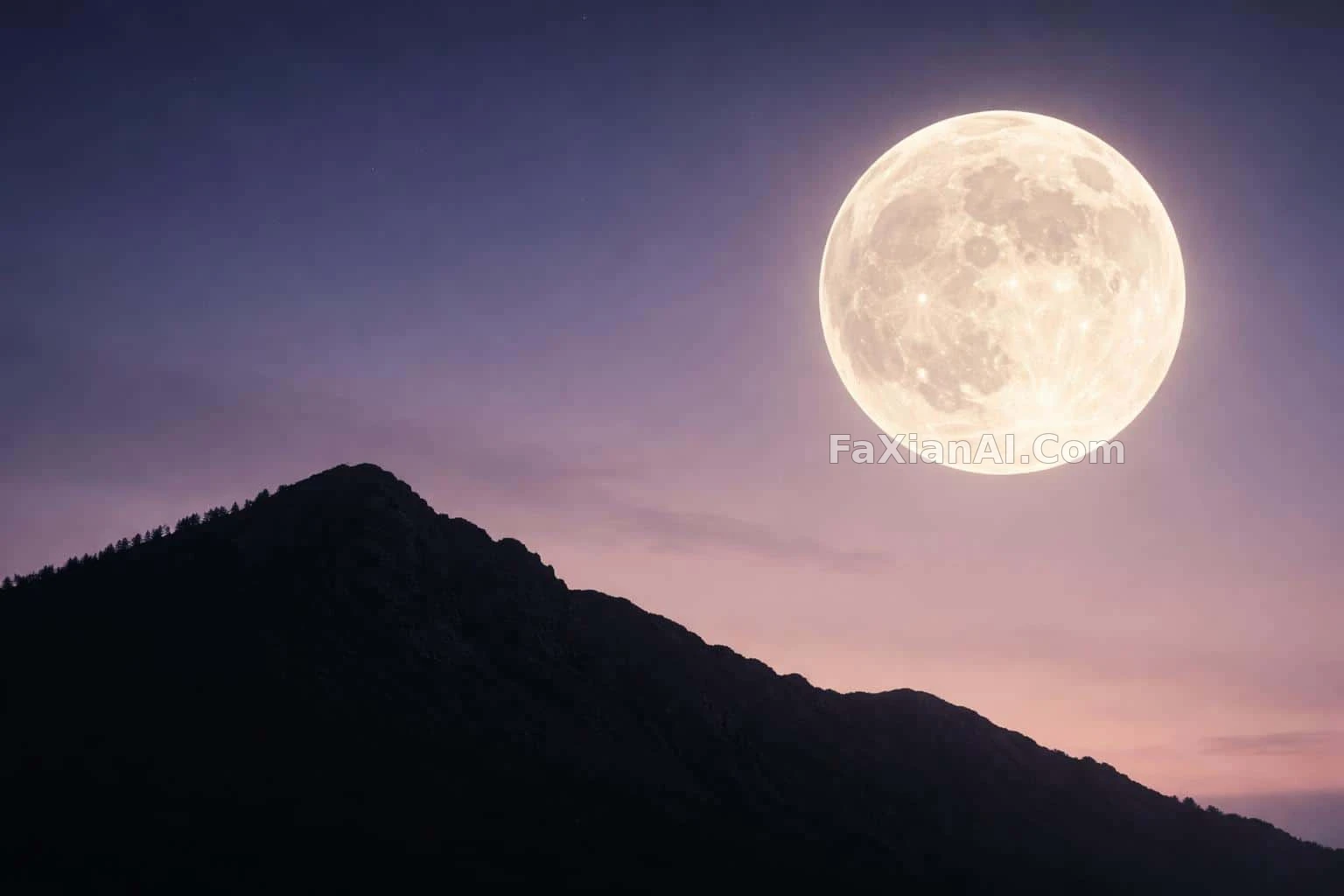
A dark ridge anchors the lower third, a full moon fills the upper frame, and the cool-warm twilight gradient just falls into place on its own.
✍️ The focus here is on two specific ratios — the peak landing at the left-third intersection, and the moon taking up the upper two-thirds; center it and the asymmetric tension disappears. The cool-to-warm gradient comes out naturally, no need to force it — let the light do what it does, the way a glaze kiln-changes on its own.
📋 Prompt Natural Language1089 characters
Frame a wide 3:2 landscape with a single dark mountain ridge sitting as a silhouette across the lower third, slightly left of center, its peak landing near the left-third intersection for subtle asymmetry. An oversized full moon takes over much of the upper-right quadrant and the top two-thirds of the frame, pale creamy surface carrying faint cratered texture and a soft halo that bleeds outward into the sky. The sky itself dominates, generous negative space opening up center-right and upper-left, rendered in muted cool-to-warm twilight gradients running from deep navy down to soft lavender. Keep the lighting soft and diffuse, a faint rim glow tracing the mountain crest, gentle gradational shadows on the slopes preserving an overall graphic flatness. Materials stay natural throughout - matte volcanic rock suggested through coarse silhouette edges, a whisper of alpine scrub along the ridge line. Read the viewpoint as a low-angle wide shot, framed for a 3:2 poster crop, calm and minimal in mood, with a shallow atmospheric haze separating the moon's plane from the ridge below.