
Write the Light Source Into the Scene: Lanterns, Crystal Lotuses, and Lava Rivers — Practical Light in Moody Portrait Prompts
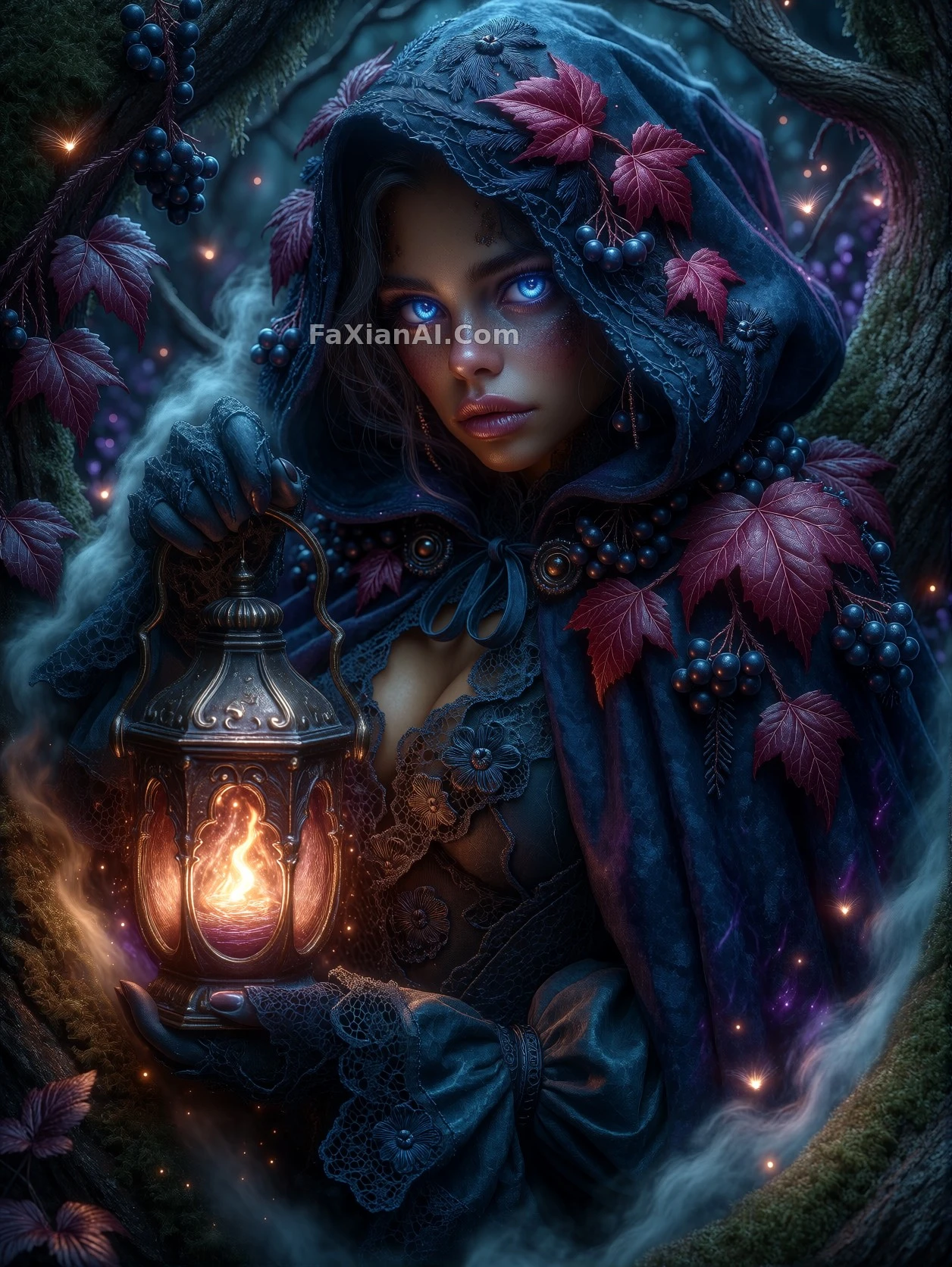
Moody portraits most often get written as a single phrase: "dramatic lighting, moody, cinematic." Feed the model those words and it tends to hand back flat, even studio lighting — the face is lit, the background is lit, and "moody" just means the whole thing got knocked down a stop of exposure.
This new batch of moody cases takes a different route: the light doesn't come from off-frame — it comes from a visible object inside the frame. A lantern, a glowing crystal lotus, a river of lava in the distance. In photography and film, this is called practical light (or motivated light). It works well with Krea 2 and the GPT Image family alike — here's how it breaks down.
1. Name the Light Source in the First Sentence
The lantern-lit forest woman prompt opens with: "An ancient, ornate metal lantern held in her hand is the only light source here." The light source comes before the person, and it uses the word only.
That only is the switch for the entire prompt. It tells the model: no fill light, don't brighten the background, every lit area in the frame has to trace back to this one lamp. The result only lights the face and the ivy embroidery on the hood, and everything else stays in cool blue shadow — which is exactly the moody effect you're after.
The fairy queen in cathedral ruins phrases it differently: "the flower functions as the scene's true light source." The light source is now the crystal lotus in her hand, but the logic is the same — give the light source a clear identity, then declare it the "only" or "true" light source.
The transferable move: describe the light source as a prop in the scene — say what it is, whose hand it's in, how far it is from the face — then add "is the only light source" or "is the true light source in the scene."
2. Write Where the Light Lands, and Where It Doesn't
Once you have a light source, the next step is defining its reach. Here's the counterintuitive part: writing what stays dark often matters more than writing what's lit.
The liquid-hematite armor on a volcanic veranda case is the most direct: the warm red glow of distant lava lights one side of her face and velvet, while the other half sinks into cool twilight shadow. As soon as the word half shows up, the model knows to leave half the frame dark, and the drama of the side light follows from that. It also specifically writes that the wine-red velvet "swallows the light rather than reflecting it" — absorbing rather than reflecting, which makes the metal breastplate the only material catching highlights. Light is what establishes which material takes priority.
The close-up with the lantern held to her chin pins the light source's position down to the centimeter: "held just below her chin," with light raking upward across half the face. Underlighting is rare in portraits and usually reads as horror-movie lighting, but paired with porcelain skin, tiny white flowers in her hair, and blurred fireflies, the result here is mysterious rather than scary. The more specific the position, the less likely the model is to move the lamp to the front on its own.
3. A Cool Environment Is the Backdrop That Makes Warm Light Work
Practical light sources are almost always warm (fire, candles, lamps), and they only stand out because the surrounding environment is cool enough.
Most of these cases write the cool environment right alongside the light source: the forest woman's "cool, dark-blue and violet shadows," the "dark, moody stone arches" behind the fairy queen, the "cool, dim twilight shadow" of the lava armor, the "surrounding teal shadow" in the harbor keeper's painterly portrait. Warm-cool contrast isn't a style preference here — it's what makes the practical light work at all. Warm up the environment, and the lamp gets swallowed.
The harbor keeper case also demonstrates a second job for the light source: it writes "warm lantern light rising from below lifts the face, mask and parrot out of the surrounding teal shadow." The light "lifts out" three things at once, and in doing so decides what the viewer looks at first and second. Here, the light source is doubling as the composition's visual guide.
4. A Light Source Can Also Be Far Away — But Give It a Job
A practical light source doesn't have to be in someone's hand. The fisherman and lantern-girl in the mist case has two light sources: the girl's lantern up close spills amber light across the deck, while a distant lighthouse beam cuts through the fog, guiding the boat home.
The near light illuminates the figures; the far light tells the story. The lighthouse beam only takes up a small piece of the frame, but it's what turns the image from "two people sitting in a boat" into "they're on their way home." When you write a distant light source into a prompt, giving it a verb (cuts through, guides, spills into) does far more work than just writing "a lighthouse in the distance."
The same idea works for architecture too: the little library between two trees writes "glowing windows spill warm amber light into the surrounding leaves" — the windows are the light source, warm light spills onto the leaves, and "cool twilight-blue shadows" hold down the surrounding area.
5. A Drop-In Sentence Template
[PROP] held [POSITION] is the only light source in the scene — its warm [COLOR] glow lights [WHAT IT LIGHTS], while [WHAT STAYS DARK] falls into cool [COLOR] shadow.
Here's a filled-in example: A brass oil lamp held at chest height is the only light source in the scene — its warm amber glow lights her hands and the pages of the open book, while the bookshelves behind her fall into cool slate-blue shadow.
6. Three Easy Ways to Blow It
1. You write the light source, then tack "bright, well-lit" onto the end anyway. The two lines fight each other, the model splits the difference, and the moodiness disappears.
2. Too many light sources. A lamp plus a sky full of stars plus a streetlight outside the window — every one wants to be bright, and the image goes flat. Keep exactly one main light source, with at most one distant narrative light on top.
3. Writing the light source but not the environment color. Without a cool backdrop, warm light just reads as "a bit yellow."
This approach is two sides of the same coin as changing the light in the same scene: that piece swaps light to change mood, this one uses a light source to set hierarchy. If you also want light to carry material texture, notes on material, edges, and light prompts goes further into that.