Home › Creative Ideas › Negative Space Makes That Branch Impossible to Miss
Negative Space Makes That Branch Impossible to Miss
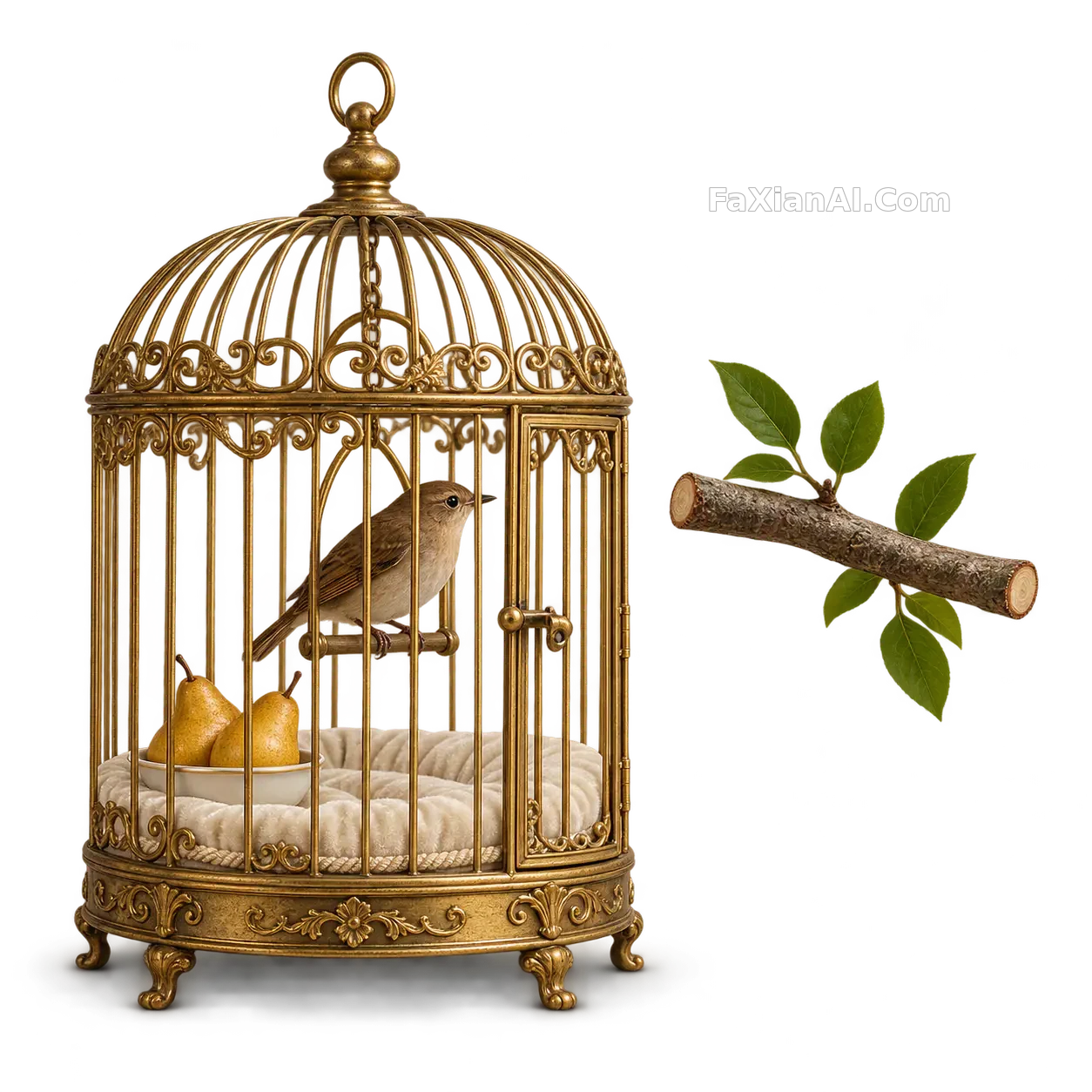
Where the bird's eyes point matters more than the whole cage — the composition hands the focus to the empty space outside the frame.
✍️ The tricky part is the spacing between that branch and the four edges of the frame — without spelling out how much room to leave, the branch shrinks into a corner and looks stingy. The bird itself is the easy part; just let the light handle it.
📋 Prompt Natural Language1370 characters
A small songbird sits inside an ornate gilded cage, perched on its interior swing while a cream velvet cushion and a pair of ripe pears on a plain little dish share the space with it; the single door stays firmly shut behind a small latch. Rather than looking at any of that comfort, the bird tilts its head toward the bars, its gaze fixed on a short cut branch segment hovering just outside at the exact height of its own eyes — a complete piece with both trimmed ends visible, holding nothing, floating well inside the frame with generous clear space from every border.
Shot as conceptual still-life photography under soft daylight from the side, the antique gold cage shows finely scrolled bars, its cream velvet plush against the ripe gold of the pears, fresh green leaves, and warm brown plumage.
Square 1:1 framing isolates the whole grouping on a genuinely transparent background — alpha channel set to 0, never white, never a solid color, no checkerboard fill — with every element kept fully inside the frame and clear margin on all sides as the transparency runs unbroken to every edge; the branch and its leaves must never touch or cross the border. A faint contact shadow, semi-transparent black within the alpha channel, gathers directly beneath the cage base and fades outward. All surfaces stay plain and unmarked, with no lettering anywhere in the shot.