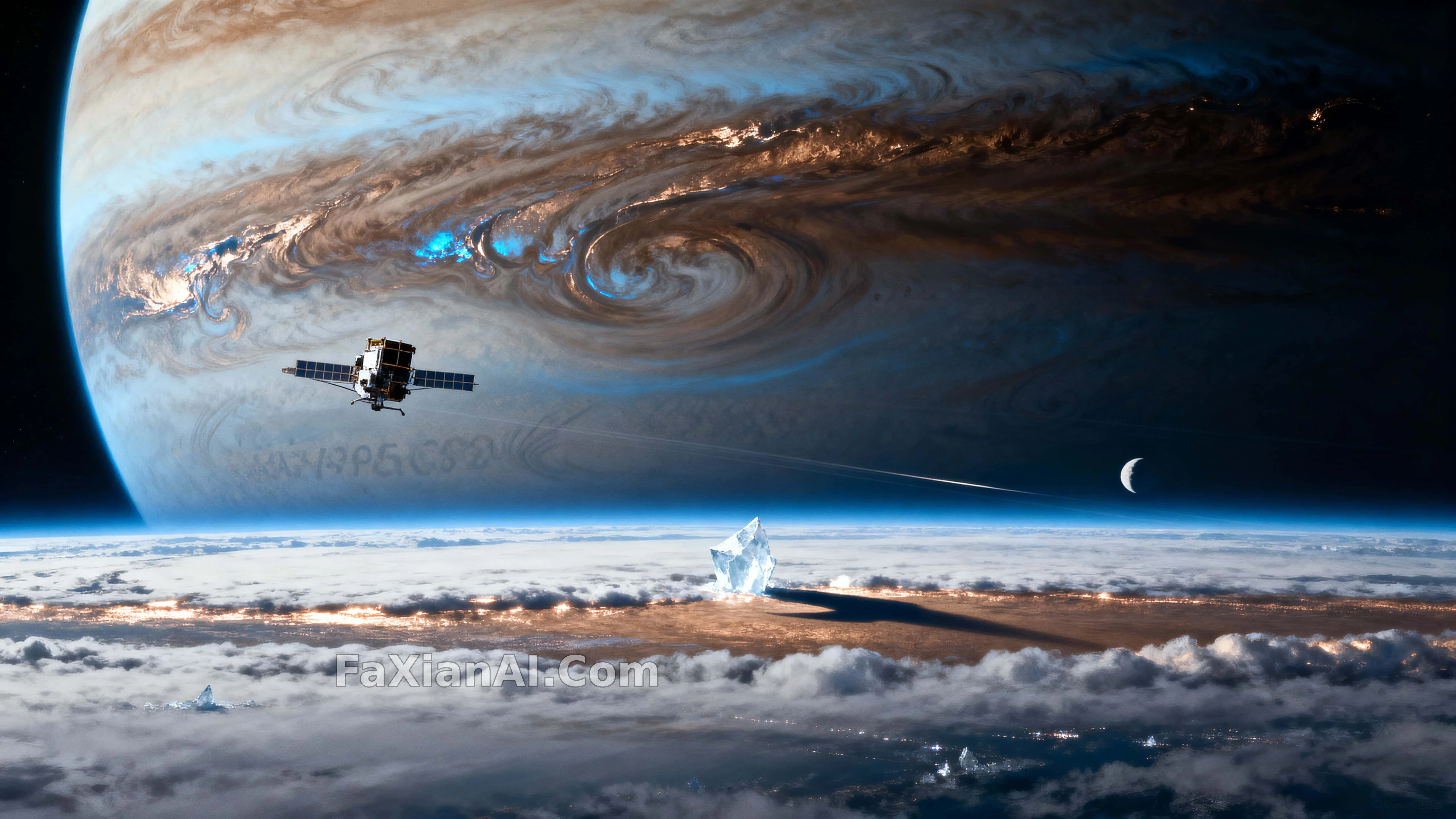
A Probe Skims Past a Gas Giant
A single ice moon crosses the planet's shadow, and it alone carries the entire sense of scale.
✍️ This structure is worth copying verbatim: scale first, then texture, then light — get the order right and the reader's eye follows that same path. Nailing the color down to a six-digit hex code is basically writing the grading rubric right onto the page — nothing left to argue about when it's time to revise.
📋 Prompt Natural Language1471 characters
A probe drifts close past a gas giant, the planet filling a cinematic 16:9 frame with broad, swirling storm bands and metallic cloud layers that catch light like beaten metal, in #0B3D91 blue and #C08A2E bronze. Aim for an intimate scientific portrait that still feels vast and reverent — a tiny ice moon silhouetted as it crosses the planet's shadow, giving the frame a moment of scale. The upper atmosphere reads dense and layered: glossy metallic textures, velvety storm rifts, a thin reflective haze picked out in cool #2A9D8F and neutral #BFC3C7 highlights. Keep surfaces unlettered and clean, planetary detail dominant, micro-markings reduced to abstract cloud streaks. Hold a tight-to-medium crop that emphasizes curvature and band junctions, keeping the moon near the lower third of the 16:9 frame for balance. Let the foreground bands resolve crisply, with shallow-to-moderate depth so the nearest cloud tops stay sharp while deeper belts soften into layered distance. Soft directional sunlight sculpts form and lifts a gentle rim glow along the cloud edges, so the whole reads as cool-warm contrast. The lone ice moon works as a deliberate prop and scale cue, catching glints and casting a thin crescent shadow across the cloud tops. Render as a highly detailed photoreal digital painting, painterly microtexture, subtle filmic grain implying probe optics. Motion stays implied — through streaked banding and the moon's crossing — for a quiet, cinematic energy.