Home › Creative Ideas › On a Salt Flat, Scale Against the Tiny
On a Salt Flat, Scale Against the Tiny
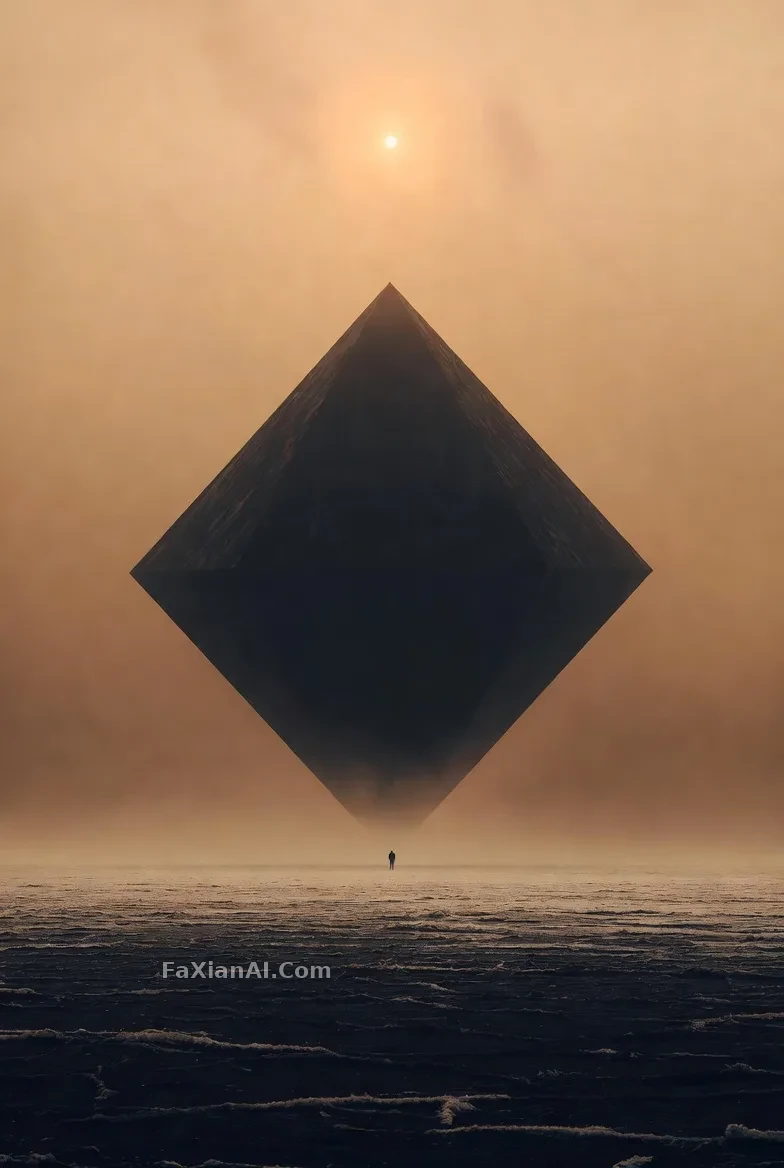
The straighter the horizon, the smaller the figure reads — scale is always built through a reference point, never through adjectives.
✍️ The real variable that matters is that razor-sharp horizon line, not the megastructure itself — the flatter and straighter it is, the more believable the figure's smallness becomes. The same contrast logic works for any colossal subject; lighting is just a secondary layer.
📋 Prompt Natural Language1106 characters
A single human figure, reduced to a minute speck, stands isolated at the base of a colossal ancient Vault — a gargantuan, miles-high asymmetric geometric polyhedron sheathed in dark matte obsidian with a dull oily sheen. The scale gap dominates the frame: the figure's tiny silhouette is dwarfed against the structure's massive vertical facets, planted on a vast, completely flat [terrain: salt crust plain] that runs to a razor-sharp horizon. Overcast, low-contrast daylight filters through a thick [sky color: dusty orange sky], a hazy dim sun throwing long, faint, diffuse shadows across the crust. Captured on a wide-angle anamorphic lens with deep depth of field, holding both the cracked salt texture in the foreground and the polyhedron's summit in sharp focus. Palette restricted to industrial monochrome — deep slate greys, matte carbon black, muted sandy ochre dust. Treat it as a wide-angle sci-fi film still, a production concept art plate. Avoid lens flare, glowing neon lines, high-contrast cinematic bloom, motion blur, vignette, watermarks, extra background figures, and organic landscapes.