
Giant Objects, Tiny Crews: Three Scale Switches in Miniature-People Prompts
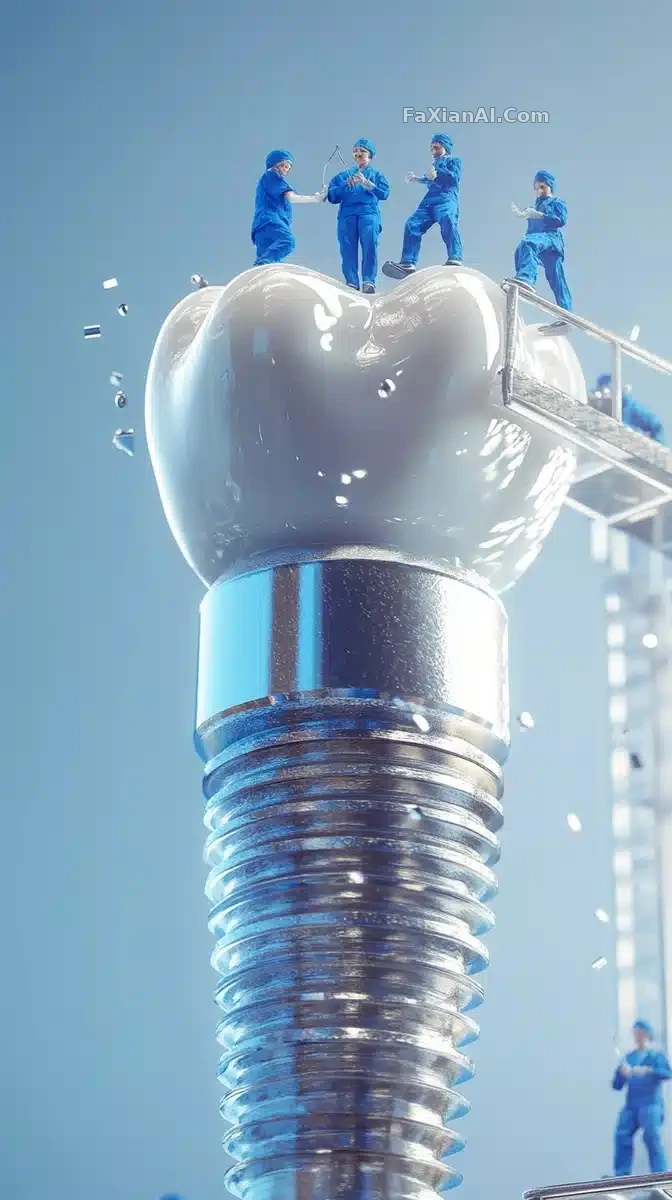
"A crew of tiny people at work on a giant object" has been a popular image type these past couple of years: a dental implant, a red stiletto, a huge fish, a strand of black hair, all crawling with miniature workers in uniform. It looks great in theory, but in practice it goes wrong a lot — the tiny people blur into noise, or the object shrinks down to ordinary size and the whole image turns into an unremarkable still life.
The cases on the site that actually hold up mostly nail the same three things.
1. Give scale as a number, not just an adjective
The dental implant case is the most direct about it: the tiny workers are "roughly 1/20 scale," about a twentieth the size.
The model obviously knows the words "tiny" and "miniature," but they carry no actual measurement. Hand it "very small people" and it will often give you figures at roughly a third scale, standing next to an object only slightly larger — and the miniature feeling disappears entirely. Write "1/20 scale" instead, and the implant fills the frame top to bottom while a person stands only as tall as one or two threads — that gap shows up reliably.
The same prompt has another detail worth borrowing: the background color is given as exact hex values (#4B6EA9 fading to #AFC7E5). The blue gradient locks in a "medical tech" feel, and since the tiny crew's blue coveralls share the same color family as the background, the crowd of figures never turns messy.
The transferable move: write scale as a fraction or a multiplier — that does far more work than stacking three "tiny"s.
2. Scaffolding and cranes are scale references, not decoration
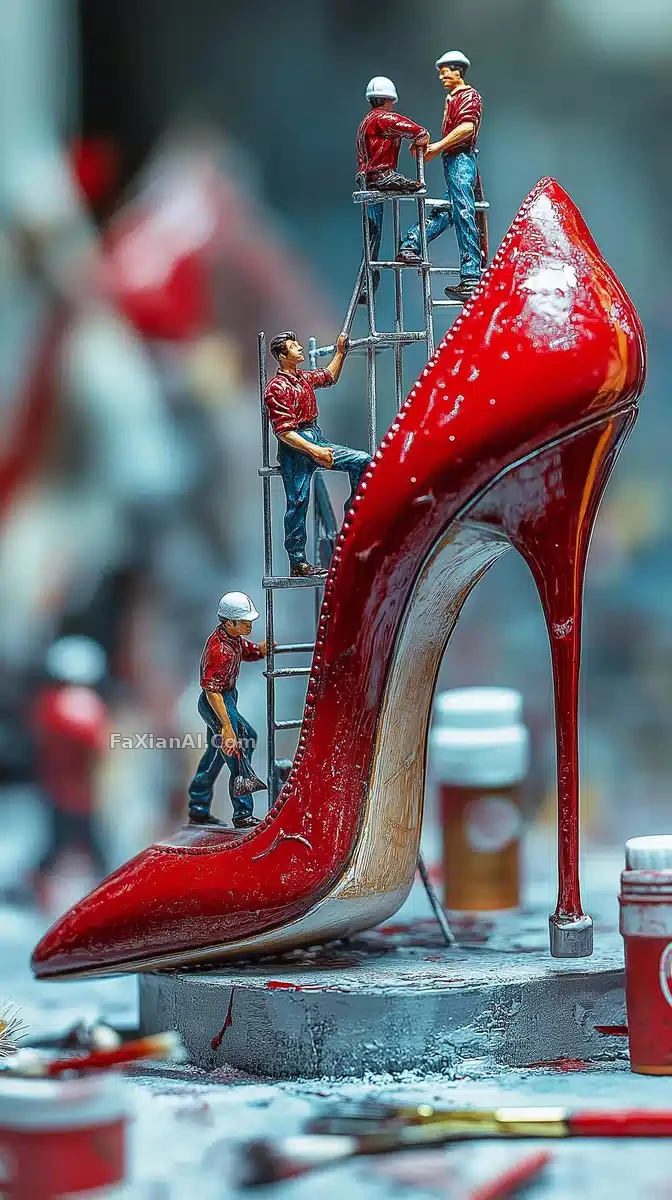
Almost every case that works includes one man-made "small structure":
- in giant fish sliced for sashimi, the chefs stand on scaffolding built around the fish's body;
- in restoring a red stiletto, some of the crew has scaffolding rigged straight onto the shoe itself, while others work at ground level with small paint cans;
- in tiny chefs plating fettuccine, there's a small crane lowering a spoon to drizzle sauce over the noodles, with one chef harnessed and hanging off the crane arm.
The human eye judges size by comparing it to something familiar. Stand a person next to a shoe and you can't be sure how tall they are — but everyone has a sense of a scaffolding level's height or a crane's proportions, and once those appear, you no longer need to explain how big the shoe or the noodles are. Another case on the site, a miniature crew building a comic book scene, pushes this further: it treats an entire open comic book as a "narrative construction site under work," with characters scaling the panel borders like scaffolding — the pages themselves become the structure.
The transferable move: give the tiny crew one piece of construction gear — scaffolding, a crane arm, a ladder, a tool cart — and the sense of scale takes care of itself.
3. Spell out who the real subject is
The red stiletto case has one crucial line: the workers "are the true focal point" — they're what the image is actually about.
Skip that line and the model will most likely treat the shoe as the subject, putting the lighting and focus on it, and the tiny workers end up as texture on the shoe's surface. Write it, and each figure gets rendered as an individual — the creases in their coveralls, the brush in their hand, the angle of their bent back.
The hair-strand lab case phrases it differently: "every tiny figure stays in sharp focus." Macro subjects naturally come with shallow depth of field, so without that line, anyone standing farther back will end up blurred.
Interestingly, the comic book scene case goes the opposite direction on purpose: it asks for extremely shallow depth of field, focus locked on just one or two "lead workers" in the foreground, everything else melted into creamy blur, and explicitly forbids full-frame sharpness. Both approaches are valid — the difference is whether you want the busy energy of "a whole crowd at work" or the narrative feel of "watching one person do the job." The model won't make that choice for you; you have to write it in.
4. It works with animals too
A cat chef's miniature kitchen swaps the workers for cats in white toques, using the exact same logic: every prop is scaled down proportionally — a tiny oven, tiny fridge, tiny frying pan — plus one line asking it to be shot "as seriously as a real cooking show." That seriousness is what makes this genre of image work — an absurd premise paired with dead-serious lighting is more interesting than going for obvious comedy.
An earlier case on the site, miniature sushi chefs assembling a dragon roll, is worth comparing too. Same idea of food plus tiny cooks, but the dragon roll case is built around division of labor — one person laying avocado slices as "dragon scales," another torching eel with a small blowtorch, another standing on a tiny bamboo bridge scattering sesame seeds. Give each figure a different action and the image tells its own story — and that little bamboo bridge happens to double as the scale reference from before.
A checklist
Before writing this kind of prompt, run through these:
1. Did you write the scale as a number?
2. Is there a piece of construction gear acting as a scale reference?
3. Did you give the focal point to the tiny crew or to the object?
4. Should every tiny figure be sharp, or not?
5. Is the light studio-cold or warm and lived-in? (The implant case uses overhead light, the fettuccine case uses warm light — completely different moods.)
If you want to push the scale contrast even further, the negative space piece covers how a large expanse of empty space can exaggerate a size difference; for more on writing parameters and aspect ratios, see the aspect ratio piece.