Home › Illustration › Miniature Crew Building a Comic-Book Scene
Miniature Crew Building a Comic-Book Scene
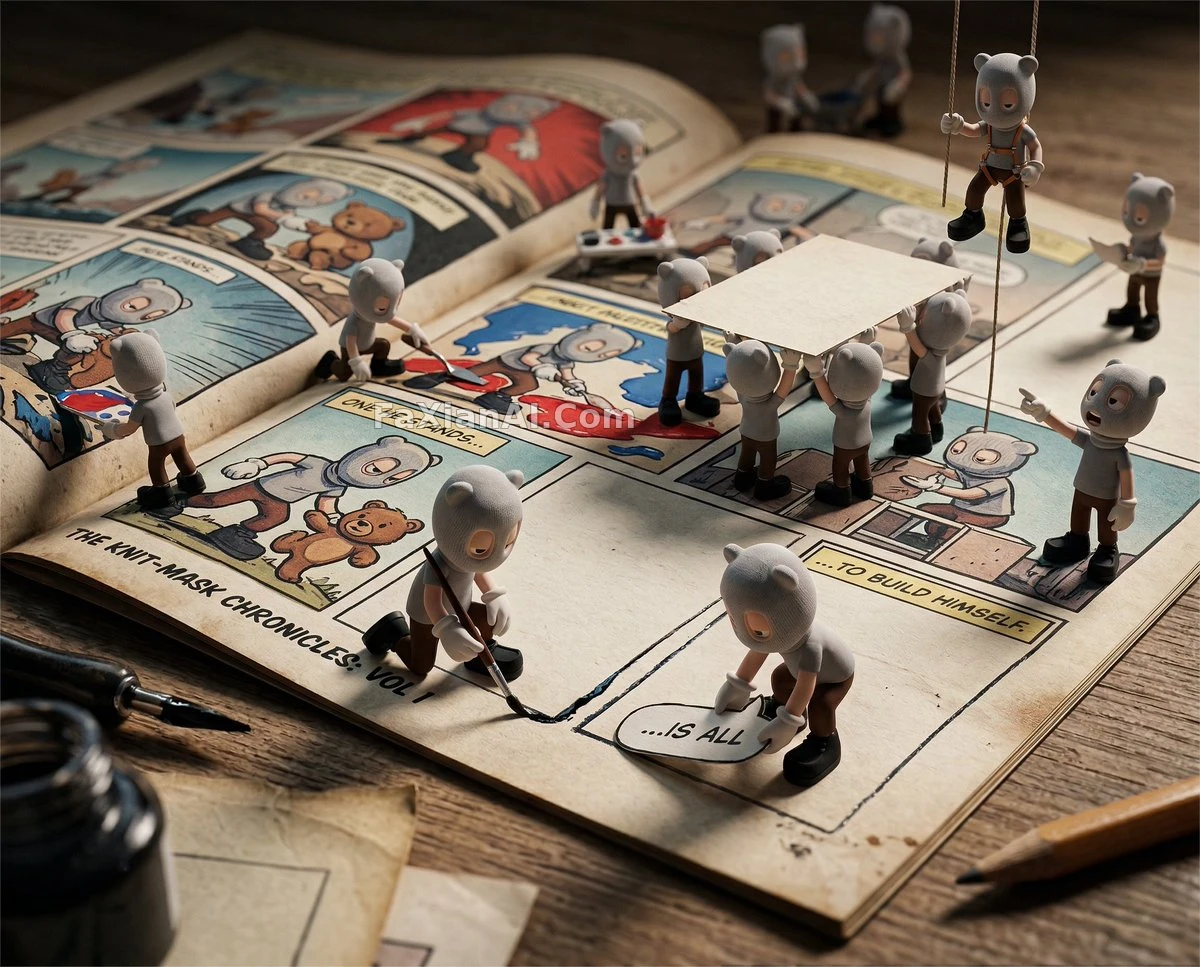
Panel by panel, this comic is being built entirely by a crew of pea-sized characters.
✍️ Here's the contrast: they're technically "drawing" a comic book, but the final shot ends up looking more like a blockbuster than the comic itself — half construction site, half print texture.
📋 Prompt Natural Language2615 characters
Cinematic macro toy photography: the uploaded reference character is duplicated into dozens of miniature individuals, all working across a giant open comic book that tells that very character's own story.
Identity integrity (CRITICAL): every miniature individual must keep the exact identity of the reference character — proportions, precise eye shape/spacing/stylization, silhouette, and material rendering must all match exactly, with no added features, no altered face, and no style drift; the artwork on the comic pages must follow the same character's design language, rendered in printed-comic linework, with no changes to the anatomy.
Scene and action: the giant comic book lies open like an active narrative construction site — miniature characters are scattered across the pages, each doing their job: some sketching panel outlines with tiny pens/brushes/styluses, some coloring inside the panels, some climbing panel borders like scaffolding, some pointing and inspecting or giving directions, and others physically interacting with the comic world itself (lifting a panel, stepping into a frame) — overall it should feel like they're building their own story in real time.
Camera: low-angle macro, camera close to the page; 90-100mm macro lens for compression rather than distortion — foreground characters appear larger only because of proximity to the lens, without exaggerated wide-angle warping; spatial depth comes from focus falloff and distance rather than scaling; the open comic book's diagonal extends into the depth of the frame, and the panel borders form strong leading lines; the composition is deliberately unbalanced and off-center, with some characters cropped by panel edges; the foreground may include blurred ink tools, paper edges, or panel borders for extra layering.
Depth of field: extremely shallow, with the main focus on one or two miniature characters actively working in the foreground; the midground is slightly soft, and the background along with its panels dissolves into creamy blur — avoid full-frame sharpness; the focal point should guide the eye to the "lead worker."
Lighting: hard, directional cinematic light from the upper left, casting sharp shadows across the paper panels; subtle rim light separates the characters from the page; ink reflections create small specular highlights; panel-edge shadows add natural depth — avoid flat lighting.
Environmental texture: paper fiber, ink texture with slight sheen, minor print imperfections, slightly raised or embossed panel borders, and small marks left by the miniature tools should all be individually discernible.