
Four Variables for Food Prompts: Light Angle, the Half-Second, Detail, and the Negative List
Most food prompts fail not because of composition, but because the food looks "fake." Food that looks waxy, sauce that looks like plastic, lighting that's flat and bright — every element is technically correct, yet nothing looks appetizing. The food prompts on this site that actually hold up almost always get four things right.
1. Lighting angle is the first decisive variable
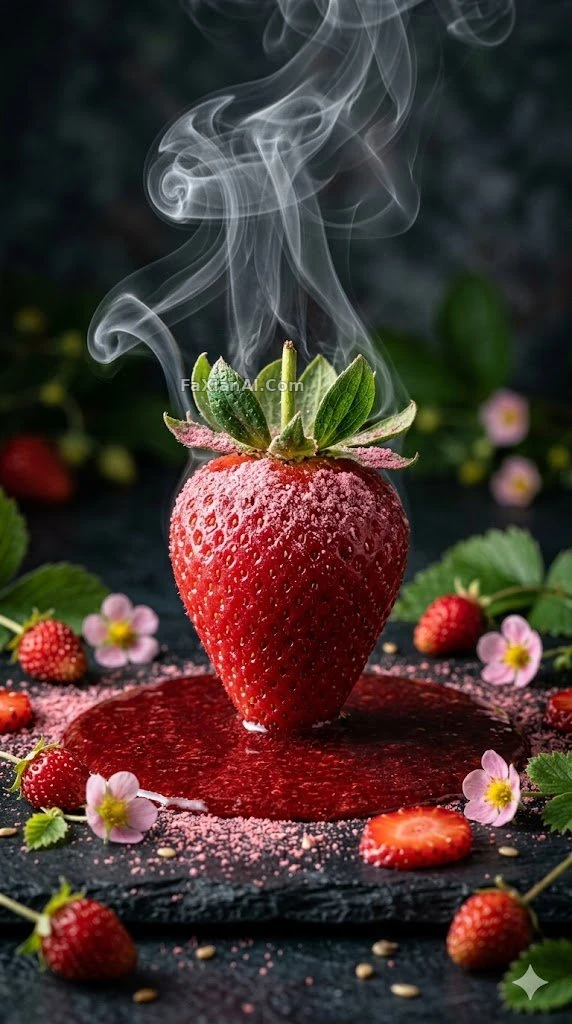
The strawberry syrup macro shot opens with lighting first: side lighting, dramatic, picking out texture, water droplets, powder granules, and wisps of smoke one by one.
When side light cuts across the frame at an angle, the syrup's thickness finally gets contrast between light and shadow, and the strawberry's fuzz and condensation droplets stand out. Swap in flat frontal light and all those elements blur into a uniform patch of red. In food photography, "dimensionality" comes almost entirely from lighting angle, not color grading in post.
A small trick for how you write it: put the lighting angle at the very front of the prompt, not tacked on at the end as an afterthought. The order the model reads things in affects what it constructs first. To see the same scene with the lighting angle swapped, there's a piece on the site called Same Scene, Different Light.
2. Write "happening now," not "already done"
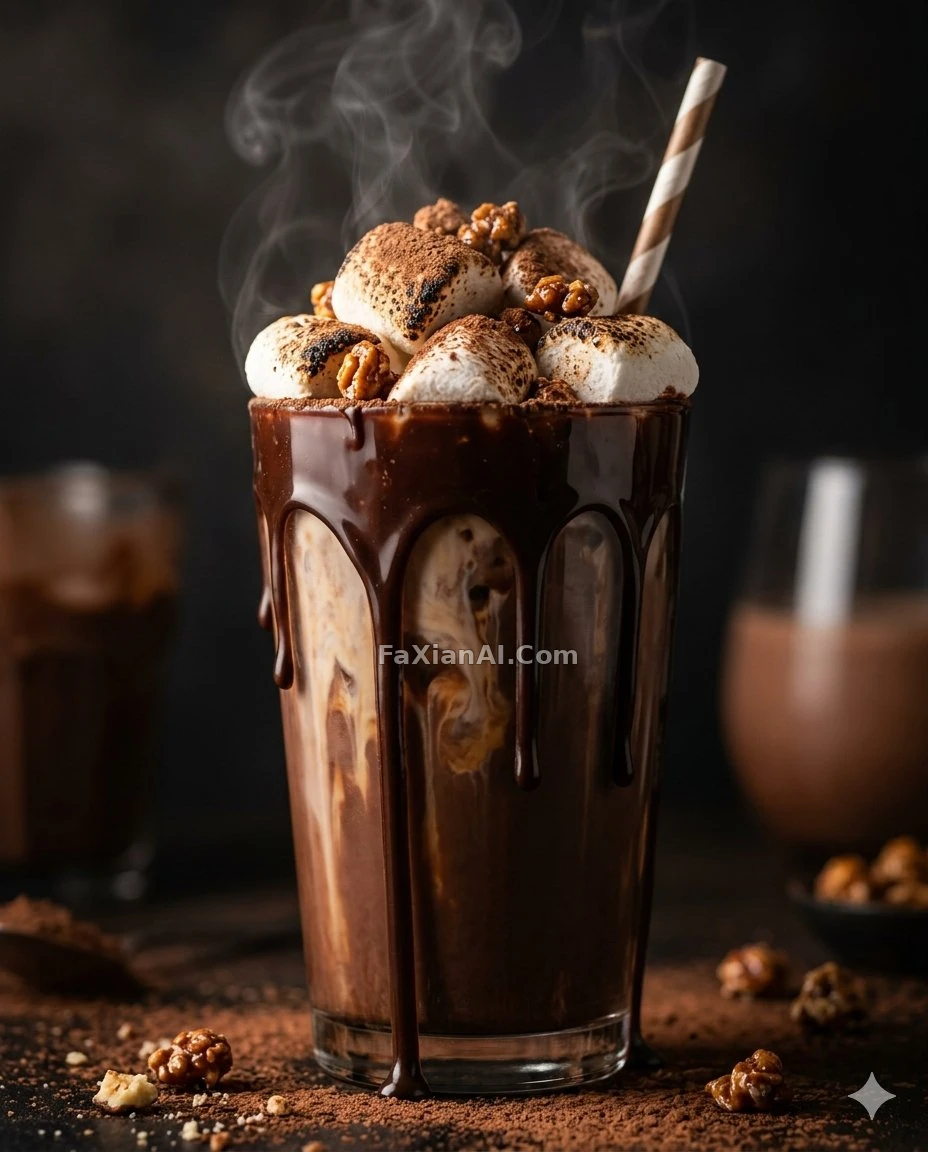
In the brownie with drizzle shot, the key detail isn't the brownie — it's two present-continuous verbs: the pitcher is "pouring" chocolate sauce, and the ice cream edge has "just started softening and melting."
Ice cream fully frozen is a still life; fully melted is a mishap. It's that half-second caught mid-softening that actually makes you hungry. That exact moment has to be locked into the prompt — the model won't pick it for you.
The same logic shows up even more clearly with drinks. Both the blueberry yogurt splash and the iced matcha latte splash prompts write "frozen mid-air in an instant" — skip that line and you'll mostly get a drink sitting quietly, liquid still in the glass.
The transferable lesson: in food prompts, verb tense matters more than the number of adjectives. "Sauce being drizzled" and "sauce is drizzling" are two different images.
3. Detail carries the warmth
The Eid dessert shot already has a full scene — gilded bowl, lanterns, archway, draped fabric. But what actually gives the image warmth are two small things: a faint wisp of steam over the bowl's rim, and scattered dried fruit on the reflective cutlery.
Steam signals just-cooked. Condensation signals chilled. A sauce that clings to the spoon signals thick. These three are "state words" in food imagery — one word can do the work of a whole sentence. By contrast, words like "delicious," "tempting," "mouth-watering" produce almost no actual image in a prompt.
When rewriting someone else's prompt, these are exactly the kind of details that get casually deleted — they look like flourishes, but they're actually information.
4. The negative list is basically all about preventing "fake"
The brownie prompt uses a structured format, and its `negative_prompt` lists a long string of terms: fake food, plastic texture, cartoonish, illustration look, CGI look, 3D render look, artificial sheen, overexposed, burnt highlights, underdone appearance...
Sort that list into categories and it becomes clear — half is guarding against material inaccuracy (plastic look, artificial sheen), half against style drift (cartoon, illustration, 3D render), and the rest against lighting accidents (overexposure, burnt highlights). Those three categories are exactly the three most common ways food images go wrong.
Models that work from natural-language prompts can use the same checklist, just flipped into positive phrasing: "preserve realistic food texture, avoid plastic sheen and rendered look." For the full structured-prompt format, see How to Write Structured Prompts.
One extra e-commerce trick
The iced matcha prompt buries one more move: a phone in the background, its screen showing a social post about the same drink. It's the product advertising itself, inside its own image.
This trick works for any category — a screen, a shelf, a package in the background can all carry a second layer of information. Far more effective than just piling props next to the main subject.
A checklist to run before you write
- Did you specify the lighting angle — side or top — and put it at the start?
- Is the key action in present continuous tense (pouring, melting, frozen mid-air)?
- Is there at least one state detail: steam / condensation / clinging sauce / crumbs?
- Does the negative list cover all three categories: material, style, lighting?
- Is the background going to waste — could it carry a second layer of information?
More food-category examples keep getting added to the site. For more comparisons on how to write subject, material, and space, see Subject, Material, and Space in Practice.