
Scale Is a Relationship, Not an Adjective
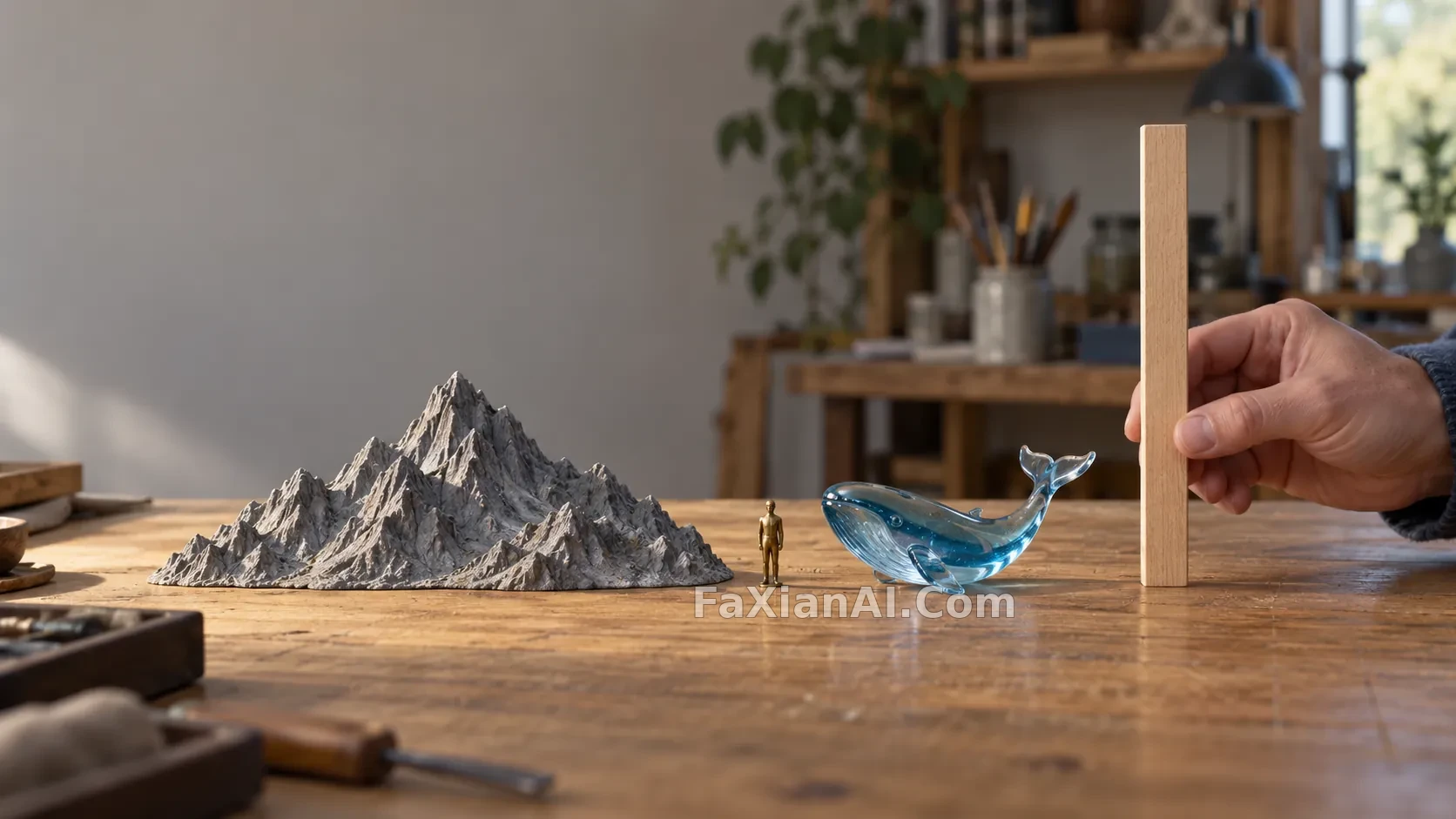
“Huge” and “vast” state a conclusion. They do not tell an image model how a viewer will recognize the size. Scale needs a reference: where a person stands, what carries an object's weight, and how far the landscape recedes. The four cases below put those cues in different parts of the frame. Decide what the viewer will compare before choosing a camera and light.
Give a giant object several references
The glass whale at the harbor is roughly ferry-sized. Two conservators beside its fin give a nearby human measure; steel supports explain how its weight reaches the pier; distant cranes extend the comparison. Puddle reflections hold the outline of the transparent material. “A huge transparent whale” alone might produce an object floating without a believable setting.

The earlier giant cowbell among the mountains takes another route: enlarge a familiar small object and use slopes, paths and viewing distance for contrast. Both belong to giant-object photography, but one depends on terrain and the other on industrial structure. Replacing only the subject noun would miss that difference.
A distant subject should sometimes stay distant
The snow leopard on a blue-dawn ridge remains in the lower part of the frame. Its face and tail must be legible, while peaks and valley retain enough space to describe its habitat. A low viewpoint and a little morning rim light separate the animal from the rock. Turning it into a frame-filling close-up would erase the feeling of encountering it within the mountains.

By contrast, the miniature jeep on a salt flat is surrounded by a model world. The useful instructions describe model edges, materials and how close the camera sits, rather than merely saying “tiny.” A mountain habitat and a tabletop diorama both require scale cues, drawn from different sources.
Write the relationships first
A practical order is relative size, one near reference, one distant reference, camera position and light that separates the layers. Transparent objects also need supports and reflections; wildlife needs plausible anatomy and a readable habitat. For how material edges help us judge size, see the material-edge prompt guide. Browse the style cases for other media. Check generated proportions, structures and glass behavior afterward: an attractive picture does not automatically have credible physical scale.