
How to Write a Macro Prompt: Decide What's Sharp Before You Decide What Blurs

A lot of macro prompts just tack "macro, 8K, ultra detailed" onto the end of the sentence. The shot does get close, but it often comes out sharp all over, looking like a blown-up product photo rather than an actual macro shot.
What actually reads as macro is contrast: one tiny area in sharp focus, everything around it dissolving fast. The model won't set up that relationship on its own just because you wrote "macro" — you have to spell it out. The macro cases on the site that work well all handle the same handful of things.
1. Give sharpness to one place, and name it
The ring macro close-up is the most thorough about it: the model's face, skin, and hands are all softened, the other rings in the same set are "softly in focus" and serve only as composition and scale reference, and "the only sharp focus throughout is reserved for the subject itself."
That word "only" matters. Write just "feature the ring" and the model tends to render the fingers, the ring, and nearby jewelry all in equally sharp focus. Demote everything else by name, one item at a time, and the focus actually lands in one place.
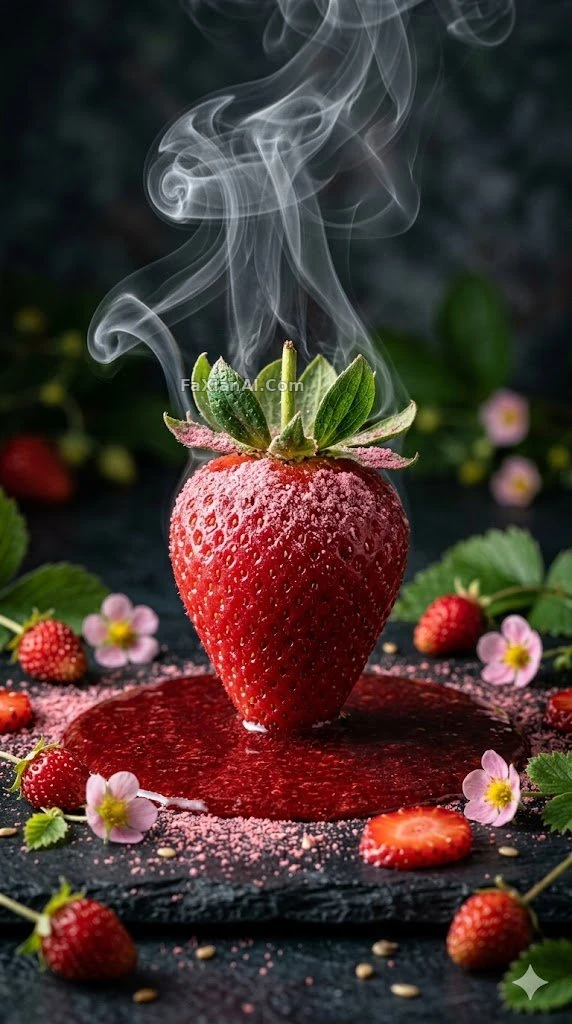
The strawberry in syrup uses the same idea: "depth of field pulled tight, focus locked hard on the center strawberry." The wild strawberries, flowers, and slices around it are written as a framing ring, already meant to blur.
The transferable move: write one line — "sharp focus only on X" — then name every other element that could steal attention and mark it soft blur or out of focus.
2. Scale needs a reference, or "macro" just reads as "close-up"
Macro reads as small because something in the frame tells you how small it is.
The Great Wave off a fingernail uses scale by contrast with something huge: a tiny painter perched on a small stool, painting on "an enormous human fingernail," with the surrounding skin pressed into soft focus. What sells the illusion isn't how well the wave is painted — it's the blur ringing the edge of the nail, which is what makes the painter read as rice-grain small.
The leaf cutout fisherman uses leaf veins and water droplets as its reference. The leaf has just been rained on and carries fine droplets, and every cutout has to stay connected along a vein rather than floating free. The droplets themselves are the scale cue — see them, and you know exactly how close the lens is.
If the frame has only an isolated subject with nothing to compare it to, the model tends to hand back a photo that just reads as "an ordinary shot, zoomed in." Adding one reference — a droplet, a fiber, a fingerprint, a grain of powder — does more than piling on extra "detailed."
3. Side light does more for macro texture than "soft light"
Macro is photographing a surface, and only side light reveals a surface's texture.
The strawberry prompt opens with "side lighting, dramatic," meant to carve out the texture, the droplets, the sugar grains, and the wisp of steam one by one. Flat frontal light would press all of that flat.
The snow-buried cream jar writes its lighting as structured JSON: crisp winter side sunlight, an 85mm macro lens, f/2.8, shallow depth of field, the jar coated in fine frost and condensation crystals. The side light is what gives the frost its dimension.
The leaf cutout prompt writes it as "soft sunlight rake across it" — a rake light grazes low across a surface, which suits leaves, fabric, and skin: anything with fine texture.
4. Write the surface evidence, not just "high resolution"
"8K" and "ultra detailed" describe resolution. What macro actually needs is something visible:
- Droplets, condensation, frost (the cream jar, the leaf, the strawberry)
- Powder and grain (sugar dust on the strawberry's surface)
- Fiber and pores (a makeup brush sweeping across skin — the prompt is a single line, but "extreme close-up on facial skin texture" already says exactly what to show)
- Metal cutwork and engraving (an obsidian-dial watch spells out its cutout structure, crown micro-engraving, and lume coating in detail)
These details are things the model can actually paint; a resolution adjective is just a demand. The more of the former you write, the less you need the latter.
5. A macro prompt checklist
1. Where's the one sharp zone? Is everything else written out as blurred, one item at a time?
2. Is there a scale reference in frame — a droplet, a fiber, a grain, or a giant object / tiny figure?
3. Which direction is the light coming from? Side or raking light is usually the better call for macro.
4. Does the lens language need to be realistic? 85mm macro, f/2.8, shallow depth of field — these work for photoreal models.
5. List two or three pieces of surface evidence rather than just writing 8K.
6. Aspect ratio: vertical suits a single upright subject (the strawberry uses 9:16); horizontal suits a scene with a visible scale contrast.
This same idea — one thing sharp, everything else dissolved — shows up in action shots too, just with motion replacing depth of field as the source of blur; see sports action prompts for that version. For product macro shots mixing glass, metal, and liquid, how to write lighting for product shots covers how to separate out the highlights.