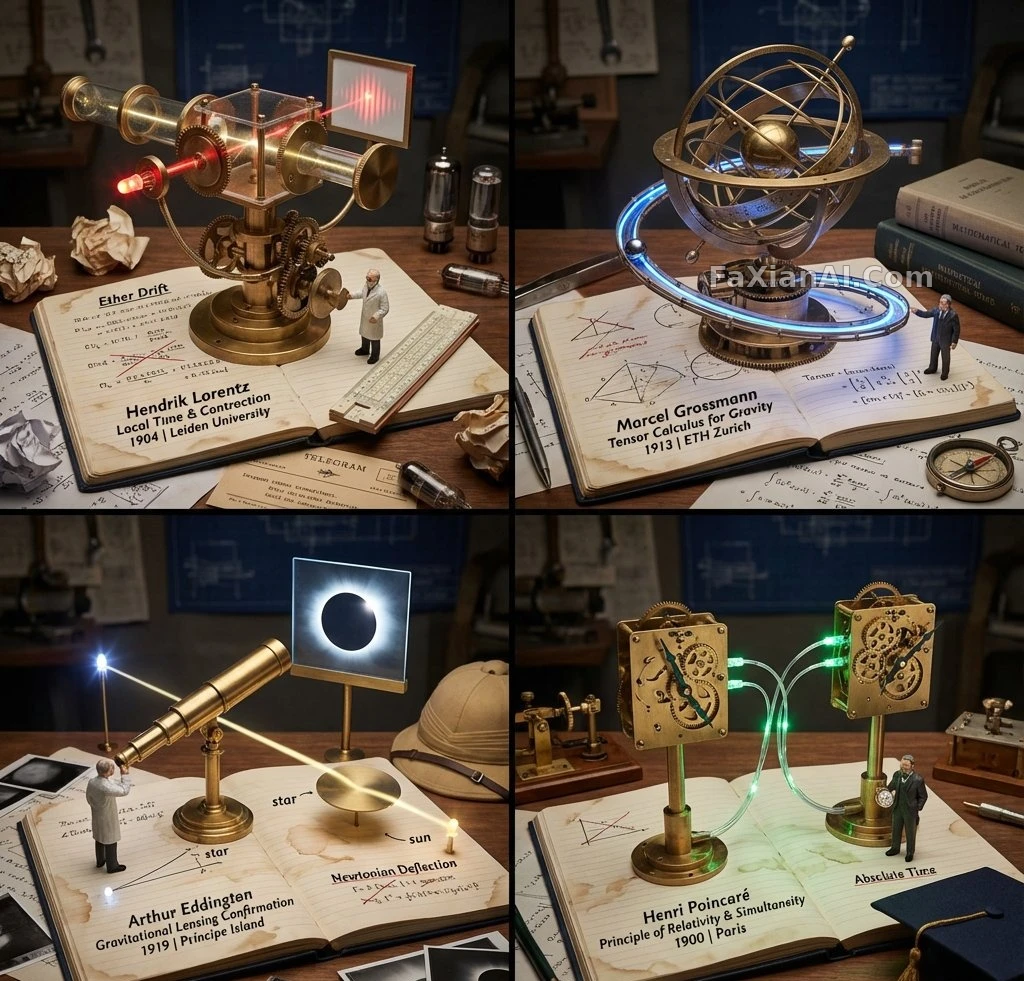
筆記本上的裝置,零件嚴絲合縫
黃銅齒輪對上方程式,失敗草稿墊底,這臺裝置的每個零件都各司其職。
✍️ 失敗草稿墊在最底下這層,比裝置本身更值得琢磨,它交代了推理過程,沒有這層,裝置就只是個好看的擺件,立不住科學史的分量。
📋 提示詞 YAML 分段式2004 字元
Role:
Science Historian & Kinetic-Sculpture Engineer
Input:
Scientific Discovery: {{DISCOVERY}}
Primary Scientist: {{SCIENTIST_NAME}}
Year: {{YEAR}}
Lab Location: {{LOCATION}}
Phase 1: Concept Analysis
Pin down the defining eureka moment behind {{DISCOVERY}}.
Hint at earlier failed attempts through subtle visual cues.
Pick the key physical apparatus tied to this discovery (telescope, prism, microscope, equation, clock, lens, etc.).
Phase 2: Visual Execution
Goal: a single 1x1 frame showing a working "lab-notebook contraption" frozen mid-discovery.
Scene Rules:
Base: an open, aged lab notebook on a wooden desk — coffee stains, handwritten equations, rough sketches, marginal notes filling the pages.
The Machine: a functional brass-and-glass apparatus rises straight out of the notebook pages. Steampunk-flavored but scientifically grounded.
The Process: the apparatus actively demonstrates {{DISCOVERY}} — light bending, gears turning, particles flowing, rings orbiting, waves oscillating.
The Scientist: a tiny, realistic figurine of {{SCIENTIST_NAME}} in period-accurate lab clothing, fountain pen in hand, taking notes.
The Failure: crossed-out equations, torn sketches, crumpled paper scattered near the notebook.
The Eureka: one subtle glowing element (LED, filament, light beam, energized ring) marking the breakthrough.
The Label: handwritten in fountain-pen style on the page — "{{SCIENTIST_NAME}} | {{DISCOVERY}} | {{YEAR}} | {{LOCATION}}".
Era Props: period-accurate tools — slide rule, telegram, brass compass, glass tubes, Bunsen burner, vacuum tubes, or notebooks.
Style & Output
Composition: single frame, centered subject, square 1x1.
Lighting: dramatic side lighting, warm highlights, deep shadows.
Texture: brass, glass, paper fibers, ink stains clearly visible.
Photography Style: industrial scientific photography, cinematic realism.
Mood: quiet intensity, intellectual tension, a frozen moment of discovery.
Quality: ultra-detailed, macro realism, shallow depth of field.
📋 中文譯寫版 自然語言766 字元
角色:科學史學家兼動能雕塑工程師
輸入:
科學發現:{{DISCOVERY}}
主要科學家:{{SCIENTIST_NAME}}
年份:{{YEAR}}
實驗室地點:{{LOCATION}}
第一階段·概念拆解
鎖定{{DISCOVERY}}背後那個決定性的頓悟瞬間。
用細微的視覺線索暗示此前的失敗嘗試。
選定與該發現關聯的關鍵實體裝置(望遠鏡、稜鏡、顯微鏡、方程、時鐘、透鏡等)。
第二階段·視覺呈現
目標:一張1x1畫面,呈現一臺"實驗室筆記本裝置"在發現瞬間被定格的樣子。
場景規則:
底圖:一本攤開的舊實驗室筆記本放在木桌上——咖啡漬、手寫方程、粗略草圖、頁邊批註寫滿紙面。
機械裝置:一臺黃銅玻璃裝置從筆記本頁面直接立起來,蒸汽朋克質感但科學邏輯站得住。
運作過程:裝置正在演示{{DISCOVERY}}——光線彎折、齒輪轉動、粒子流動、圓環公轉、波形振盪。
科學家:{{SCIENTIST_NAME}}的微縮寫實人偶,穿著符合年代的實驗室服裝,手持鋼筆正在記錄。
失敗痕跡:筆記本旁散落劃掉的方程、撕碎的草圖、揉皺的紙團。
頓悟時刻:一個不張揚的發光元素(LED、燈絲、光束、通電的圓環)標記突破的那一刻。
標籤:筆記頁上用鋼筆手寫體寫著"{{SCIENTIST_NAME}} | {{DISCOVERY}} | {{YEAR}} | {{LOCATION}}"。
年代道具:符合年代的工具——計算尺、電報、黃銅羅盤、玻璃管、本生燈、真空管或筆記本。
風格與輸出
構圖:單幀畫面,主體居中,方形1x1。
燈光:戲劇性側光,暖調高光,深色陰影。
質感:黃銅、玻璃、紙纖維、墨漬清晰可見。
攝影風格:工業科學攝影,電影級寫實。
氛圍:安靜的張力,理智的緊繃感,發現瞬間被定格。
品質:超細節,微距級寫實,淺景深。