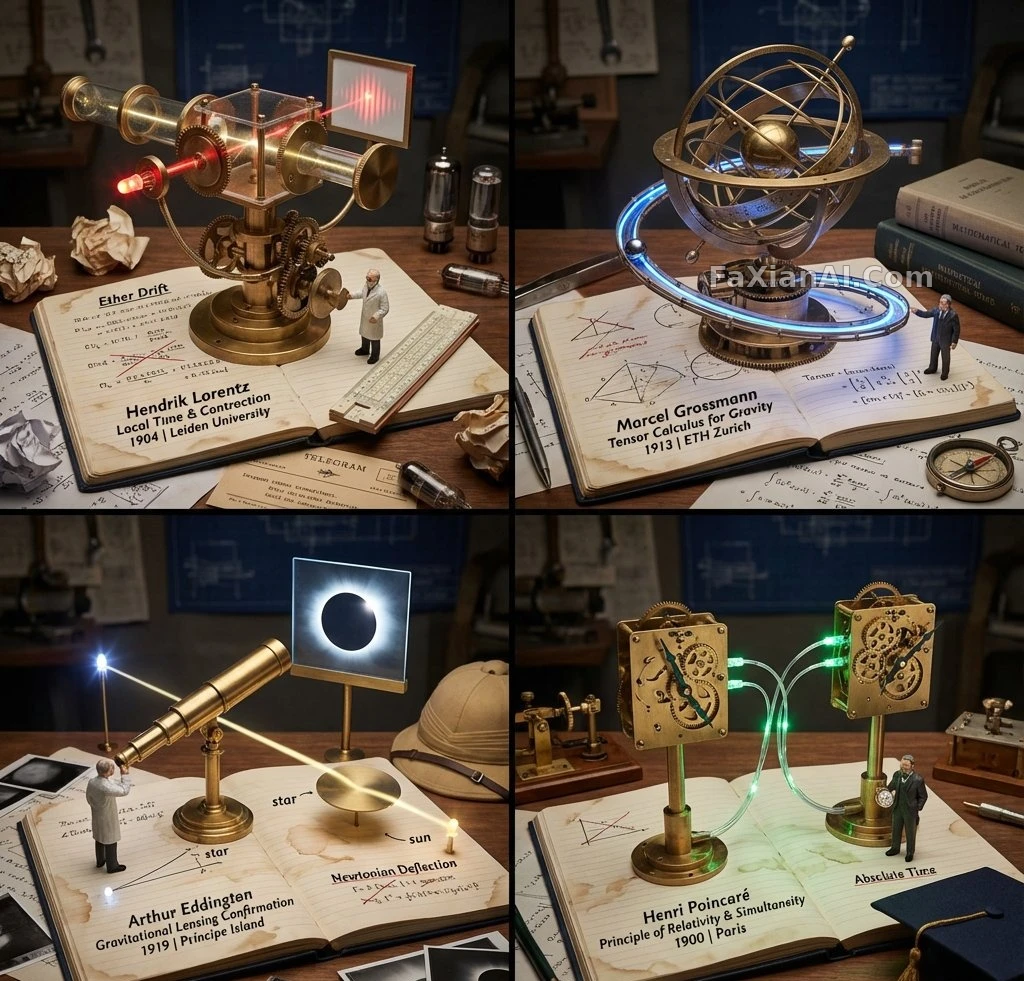
笔记本上的装置,零件严丝合缝
黄铜齿轮对上方程式,失败草稿垫底,这台装置的每个零件都各司其职。
✍️ 失败草稿垫在最底下这层,比装置本身更值得琢磨,它交代了推理过程,没有这层,装置就只是个好看的摆件,立不住科学史的分量。
📋 提示词 YAML 分段式2004 字符
Role:
Science Historian & Kinetic-Sculpture Engineer
Input:
Scientific Discovery: {{DISCOVERY}}
Primary Scientist: {{SCIENTIST_NAME}}
Year: {{YEAR}}
Lab Location: {{LOCATION}}
Phase 1: Concept Analysis
Pin down the defining eureka moment behind {{DISCOVERY}}.
Hint at earlier failed attempts through subtle visual cues.
Pick the key physical apparatus tied to this discovery (telescope, prism, microscope, equation, clock, lens, etc.).
Phase 2: Visual Execution
Goal: a single 1x1 frame showing a working "lab-notebook contraption" frozen mid-discovery.
Scene Rules:
Base: an open, aged lab notebook on a wooden desk — coffee stains, handwritten equations, rough sketches, marginal notes filling the pages.
The Machine: a functional brass-and-glass apparatus rises straight out of the notebook pages. Steampunk-flavored but scientifically grounded.
The Process: the apparatus actively demonstrates {{DISCOVERY}} — light bending, gears turning, particles flowing, rings orbiting, waves oscillating.
The Scientist: a tiny, realistic figurine of {{SCIENTIST_NAME}} in period-accurate lab clothing, fountain pen in hand, taking notes.
The Failure: crossed-out equations, torn sketches, crumpled paper scattered near the notebook.
The Eureka: one subtle glowing element (LED, filament, light beam, energized ring) marking the breakthrough.
The Label: handwritten in fountain-pen style on the page — "{{SCIENTIST_NAME}} | {{DISCOVERY}} | {{YEAR}} | {{LOCATION}}".
Era Props: period-accurate tools — slide rule, telegram, brass compass, glass tubes, Bunsen burner, vacuum tubes, or notebooks.
Style & Output
Composition: single frame, centered subject, square 1x1.
Lighting: dramatic side lighting, warm highlights, deep shadows.
Texture: brass, glass, paper fibers, ink stains clearly visible.
Photography Style: industrial scientific photography, cinematic realism.
Mood: quiet intensity, intellectual tension, a frozen moment of discovery.
Quality: ultra-detailed, macro realism, shallow depth of field.
📋 中文译写版 自然语言766 字符
角色:科学史学家兼动能雕塑工程师
输入:
科学发现:{{DISCOVERY}}
主要科学家:{{SCIENTIST_NAME}}
年份:{{YEAR}}
实验室地点:{{LOCATION}}
第一阶段·概念拆解
锁定{{DISCOVERY}}背后那个决定性的顿悟瞬间。
用细微的视觉线索暗示此前的失败尝试。
选定与该发现关联的关键实体装置(望远镜、棱镜、显微镜、方程、时钟、透镜等)。
第二阶段·视觉呈现
目标:一张1x1画面,呈现一台"实验室笔记本装置"在发现瞬间被定格的样子。
场景规则:
底图:一本摊开的旧实验室笔记本放在木桌上——咖啡渍、手写方程、粗略草图、页边批注写满纸面。
机械装置:一台黄铜玻璃装置从笔记本页面直接立起来,蒸汽朋克质感但科学逻辑站得住。
运作过程:装置正在演示{{DISCOVERY}}——光线弯折、齿轮转动、粒子流动、圆环公转、波形振荡。
科学家:{{SCIENTIST_NAME}}的微缩写实人偶,穿着符合年代的实验室服装,手持钢笔正在记录。
失败痕迹:笔记本旁散落划掉的方程、撕碎的草图、揉皱的纸团。
顿悟时刻:一个不张扬的发光元素(LED、灯丝、光束、通电的圆环)标记突破的那一刻。
标签:笔记页上用钢笔手写体写着"{{SCIENTIST_NAME}} | {{DISCOVERY}} | {{YEAR}} | {{LOCATION}}"。
年代道具:符合年代的工具——计算尺、电报、黄铜罗盘、玻璃管、本生灯、真空管或笔记本。
风格与输出
构图:单帧画面,主体居中,方形1x1。
灯光:戏剧性侧光,暖调高光,深色阴影。
质感:黄铜、玻璃、纸纤维、墨渍清晰可见。
摄影风格:工业科学摄影,电影级写实。
氛围:安静的张力,理智的紧绷感,发现瞬间被定格。
品质:超细节,微距级写实,浅景深。