Home › Style Transfer › Shibuya Crossing, Transported Back to Edo
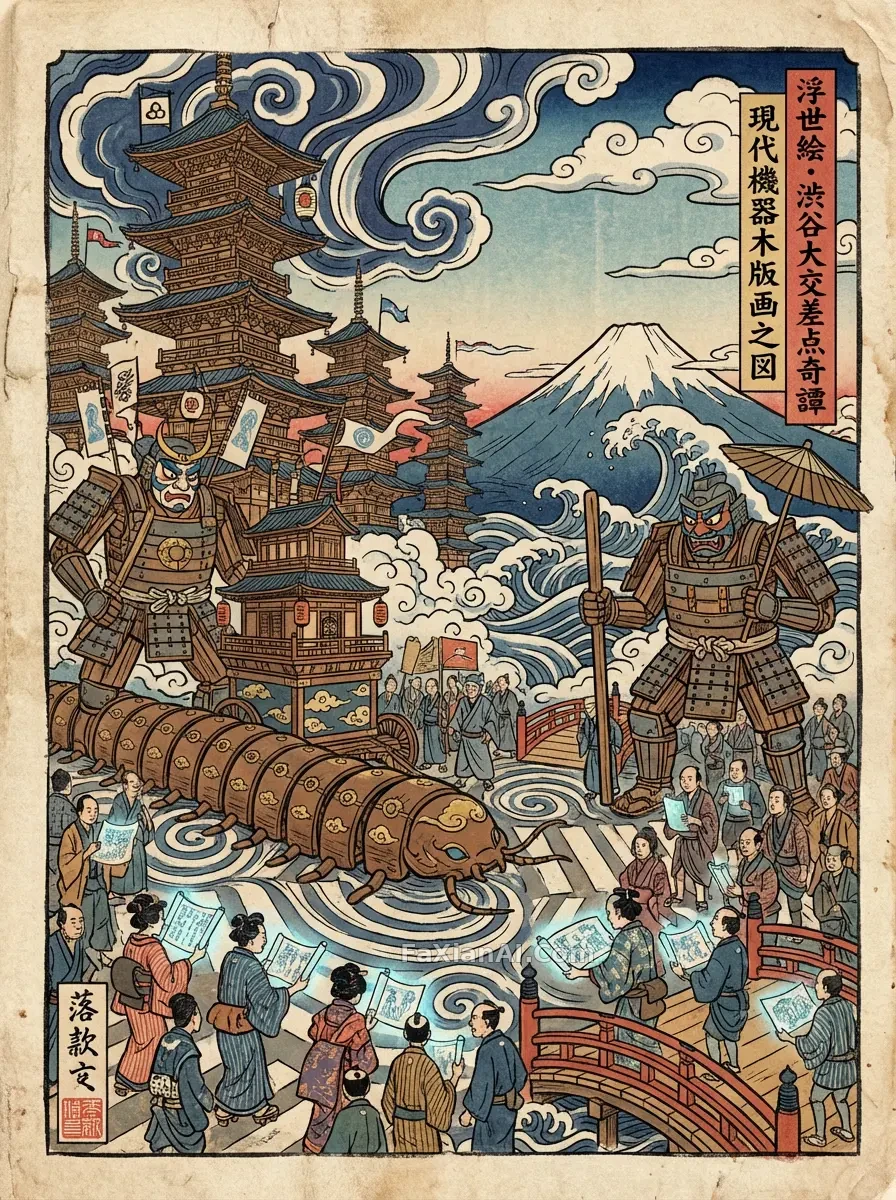
Shibuya Crossing, Transported Back to Edo
Phones become scrolls, trains become centipede carriages — this time-travel concept is cleverly built, and the wood-grain roughness lands too.
✍️ The key variable is that mapping table of 'modern tech → its Edo-era equivalent' — swap phones for scrolls, subways for centipede carriages, and the same translation logic works for any modern setting you plug in.
📋 Prompt Natural Language1725 characters
Edo-period ukiyo-e woodblock-print aesthetic, as if Katsushika Hokusai and Utagawa Hiroshige had collaborated across time to reimagine modern technological civilization through a classical lens.
**Setting:** [modern scene: the bustling Shibuya Crossing]
**Edo-fication translation logic:**
Characters wear Edo-period kimono, yet their actions are modern-day routines. All technological elements are replaced with surreal Edo-era equivalents:
* **Smartphones** become glowing hand-painted scrolls, people bent over reading the text on them.
* **Subway/trains** become segmented giant wooden centipede carriages, weaving through the crowd.
* **Skyscrapers** are reimagined as stacked wooden pagodas rising tier upon tier, piercing dramatic clouds.
* **Robots/mechs** appear as colossal armored wooden golems.
Composition uses flat perspective, with bold, striking hand-carved ink outlines (太い墨線); the background is filled with stylized ukiyo-e wave patterns and rolling clouds, Mount Fuji standing far off on the horizon.
The whole piece should read as a physical print, not a digital painting:
* **Texture:** visible wood grain (木目), coarse paper-fiber texture throughout.
* **Print imperfections:** noticeable ink bleed, mimicking hand-pressed printing, with a touch of subtle **registration misalignment (版ズレ)** for authenticity.
* **Color palette:** strictly limited to traditional mineral pigments — dominated by Prussian blue (浮世絵ブルー), vermilion, and soft ochre.
* **Lighting:** soft and flat, no shadows, no digital gradients.
* **Aspect ratio:** 3:4 vertical poster.
* **Additional elements:** a traditional red artist's seal (落款) in the corner, with a vertical column of Japanese calligraphy describing the scene.