
Visual Pun Prompts: Turning Idioms Like "Train of Thought" and "Deadline" Into Concept Photos
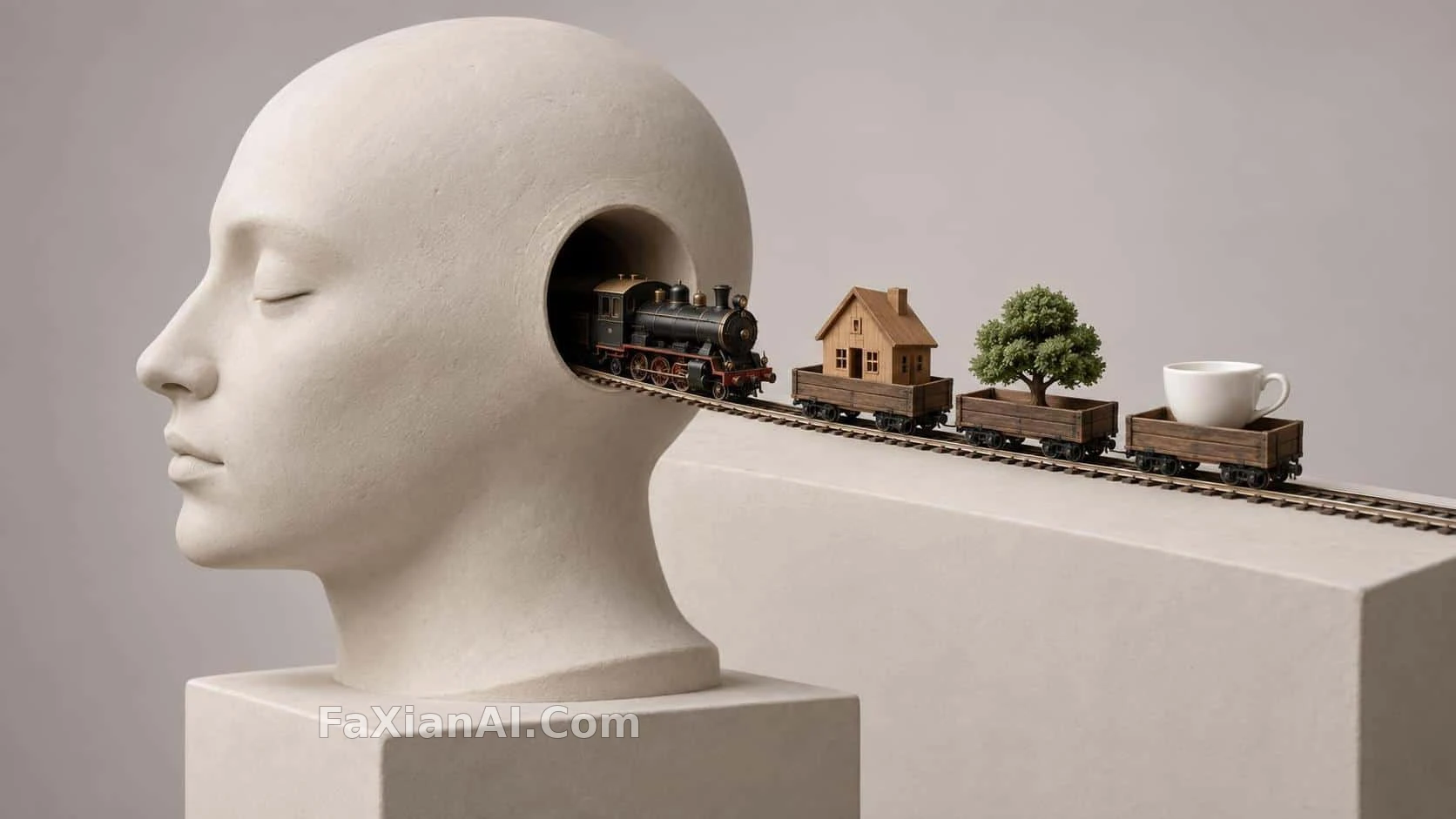
Magazine illustrations and ads have a familiar type of image: no caption needed, one glance and you know exactly which saying it's referencing. In English these are called visual puns or visual metaphors — turning "train of thought" into an actual train, or "deadline" into an actual line.
Making this kind of image with AI, the hard part isn't rendering quality — it's whether it reads. Models are good at painting a pretty object, but they don't know which detail is carrying the meaning of the phrase. The site recently added a batch of GPT Image 2.5 concept-photography cases, and their prompts are written consistently enough to make a good case study.
1. Translate the Idiom Into Something "Happening Right Now"
An idiom is abstract on its own — a model can't just paint "beating around the bush." You have to translate it into a concrete scene first: who, where, doing what.
The key knocking around a garden hedge case does this: a bright brass key stands upright in the middle of a bush, a person circles the hedge's edge tapping the ground with a wooden mallet, and a full ring of small dents already marks the ground. The goal sits right there in plain view, and the person never once steps toward it — "going around in circles" turns from a figure of speech into an actual image. The ring of dents has to be "complete, unbroken," a detail that tells you how many laps he's already made.
The clock barricade on the finish line case splits "deadline" into "dead" + "line": a row of clocks stands on the track's white finish line, the gap between the last two is closing, and an office worker clutching a folder is sprinting, exhausted, toward that closing gap. The prompt specifically insists the clocks are solid and have weight — obstacles to get past, not decorations floating in the air. Miss that line and the model will likely hand you a row of sticker-flat clocks instead.
One small rule for this kind of translation: pick a moment that "hasn't finished yet." A gap closing, a person still circling — the image carries tension, and that's what makes a viewer actually read it.
2. The Detail That Carries the Meaning Has to Be a Hard Constraint
In a visual pun image, usually only one or two details are actually "speaking" — everything else is set dressing. The prompt needs to write the speaking part as a non-negotiable rule.
The key to the train of thought rolling out of a clay head case is in the cars: three open-top cars, each carrying one different thing — a house, a sapling, a white teacup. The idea that thoughts leave one at a time rests entirely on "each car carries something different." The original prompt spells out the why to the model directly: "Each wagon carries something different, so the thought objects read plainly as they leave."
The six-legged bee working at a miniature office desk case maps to "busy as a bee." Front legs typing on a keyboard, middle legs sorting envelopes, back legs steadying a bell — three tasks, each claiming its own spot. The prompt adds one more line: "always one six-legged insect, no extra legs, no second bee" — because the moment a model tries to express "busy," it loves to paint extra legs or an extra bee, and the pun turns into a mess.
The bellows blowing the lid off a gearbox case is about "blow the lid off." A bellows blows the lid of a white box up and open, revealing a tangle of iron gears packed inside — but "not a single one has fallen out of the box." Staying contained is what makes lifting the lid land with impact; that constraint matters more than how finely the gears themselves are rendered.
3. Ban All Text, and Let the Image Speak for Itself
Almost every case in this batch carries a long "no text" declaration: the banknote is blank, the machine has no labels, the clock face has only tick marks and no numbers, there's no sign stuck in the dirt. The reason is practical — the moment text shows up in a concept image, the reader starts reading the words instead of the picture, and models are also prone to spelling errors, where one misspelled word can wreck the whole image.
As for how to write it: don't just tack "no text" onto the end. Name every object that might carry text, one by one — the banknote, the machine panel, the clock face, the mallet head, the ground. The more specific the naming, the fewer slip through. For the opposite problem — getting the model to write text correctly — see Getting the Model to Spell Text Right, which takes exactly the reverse approach and pairs well with this one.
One more habit that keeps showing up in these prompts: wherever a hand appears, the prompt spells out "five fingers per hand, visible or anatomically plausible," plus how the other four fingers grip and where the thumb sits. In a visual pun image, hands are usually doing one very specific action, and if the hand falls apart, the action becomes unreadable. For more on writing hands, see Why AI Keeps Botching Hands.
4. Give a Homophone Pun Enough "Context Props"
Some puns don't rely on an action — they rely on one word with two meanings. The beret-wearing toast clinking glasses case is exactly that: toast means both bread and a drinking toast. The prompt is short, but it doesn't skip a single prop: a slice of toast wearing a black beret, raising a stemmed glass to clink with another slice, a small French tricolor flag stuck into the table.
The beret and the little flag aren't decoration — they pin down the "French toast" layer of meaning while giving the toasting gesture an occasion. For a homophone pun, it's better to have one prop too many than to make the reader guess.
5. A Drop-In Visual Pun Template
A conceptual editorial photograph that visualizes the idiom "[IDIOM]" without any text. [MAIN SUBJECT] is [CONCRETE ACTION THAT ACTS OUT THE IDIOM], caught at the moment when [UNFINISHED TENSION, e.g. a gap is closing / the lid is just lifting]. The detail that carries the meaning: [KEY DETAIL], and it must stay [HARD CONSTRAINT, e.g. solid and heavy / fully contained / one single insect]. Supporting props: [1-2 CONTEXT PROPS]. Soft [LIGHT TYPE] light, a restrained palette of [3-4 COLORS]. Nothing carries a label or inscription: [LIST EVERY OBJECT THAT MIGHT SHOW TEXT] stay blank. Any visible hand shows exactly five fingers. 16:9 wide composition with clear margin on every side.
6. A Few Common Ways This Goes Wrong
1. The idiom is too obscure. However accurate the image, it's wasted if the reader doesn't know the phrase — favor widely recognized ones like deadline, train of thought, or busy as a bee.
2. Cramming two idioms into one image. The meanings fight each other and neither one reads.
3. The key detail gets written as an adjective. "Lots of gears" is weaker than "gears packed into the box, not one fallen out" — the second version is something you can actually check.
4. Only writing "no text." The model will sneak text onto a clock face, a banknote, or packaging anyway — you have to name each one.