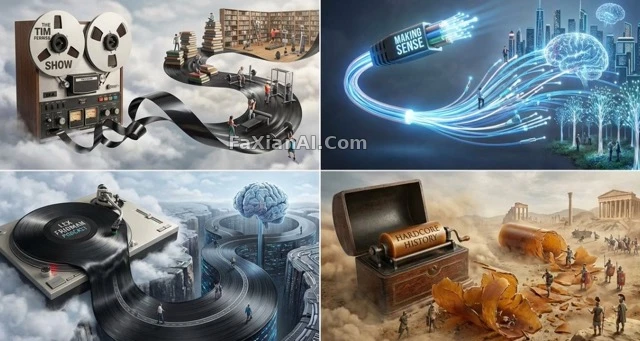
四档播客,四种媒介的物理形变条款
黑胶变峡谷、光纤变森林,每一步形变都有明确对应关系,不算夸张修辞。
✍️ 介质选对了场景才立得住,黑胶对应峡谷,光纤对应森林,这是一套对应关系,不是随便找个漂亮画面凑数。少了这层逻辑,超现实就成了乱堆意象。
📋 提示词 自然语言927 字符
Role: Surrealist Set Designer working from Input Variable [INSERT PODCAST NAME].
Build a 2x2 grid, one panel per result.
Step 1 — Curation: shortlist 4 "hidden gem" podcasts that echo the Input in tone.
Step 2 — Medium Inference: for each pick, assign the physical recording medium that best matches its sound (Vinyl, Magnetic Tape, Fiber Optic Cable, Wax Cylinder, etc.).
Step 3 — Composition: let that medium unspool or unravel loose into open air.
Step 4 — Mutation: as it unravels, have it morph directly into the podcast's Setting.
Step 5 — Texture Logic: keep the environment textured like its source medium — a glossy black "Tape" river, a glowing "Fiber Optic" forest, a carved "Vinyl" canyon.
Step 6 — Interaction: scatter tiny figures navigating this twisting, floating ribbon of media.
Step 7 — Label: mark the spool or connector with [Podcast Name].
Output: a 2x2 panel grid, each cell dedicated to one gem podcast.
📋 中文译写版 自然语言
角色设定:超现实主义置景设计师,输入变量为[播客名称]。
目标:做一张2x2网格,每格对应一个结果。
第一步·甄选:围绕输入播客的调性,挑出4档"冷门宝藏"播客。
第二步·媒介推断:为每档播客匹配最贴合其声音质感的实体录音媒介(黑胶、磁带、光纤电缆、蜡筒等)。
第三步·构图:让这段媒介松开、散开,飘向半空。
第四步·形变:媒介散开的同时,直接变形成该播客对应的场景。
第五步·质感逻辑:环境保留媒介本身的纹理——比如泛着光泽的黑色"磁带"河流、发光的"光纤"森林、雕刻出的"黑胶"峡谷。
第六步·互动:让微小的人物穿行在这条扭曲、悬浮的媒介缎带上。
第七步·标签:卷轴或接口处写上[播客名称]。
输出:一张2x2网格图,每格对应一档宝藏播客。