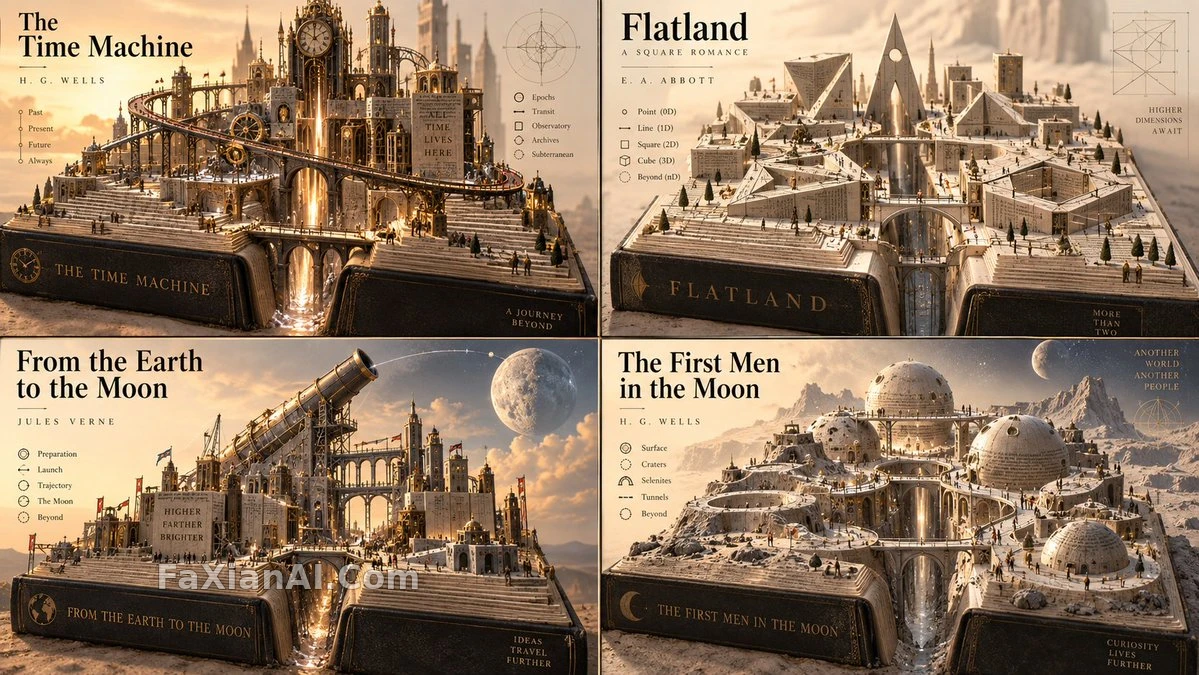
一本书能拆出一座城,你敢信?
书名加一个母题,拆成塔桥广场三件套,段落变楼层,这个脑洞是真敢想。
✍️ 这套玩法真正的变量在那条'交通路径'——必须从句子本身的流动节奏里抽出来,对应成河流或铁轨,少了这条路径城市感就只剩一堆孤立建筑,凑不成一座城。换本书套进这套规则,照样能跑出来。
📋 提示词 自然语言1182 字符
2x2 grid, 16:9, pick four public-domain works carrying no copyright.
Input A: a book title plus its motif. Analysis step: translate that motif into three architectural forms -- tower, bridge, plaza -- and one circulation path (river, road, or rail) traced out of the sentence's own flow.
Goal: the book unfolds into a habitable micro-city engineered entirely from typography.
Rules -- Container: the hardcover becomes the foundation slab; the page edges become stepped terraces; the gutter becomes the central canyon. The Transformation: paragraph blocks turn into monolithic buildings; italics become spires; drop caps become obelisks; footnotes become subterranean tunnels. The Details: scale figures, scaffolding built from paper clips, hairline cracks running through the ink 'stone,' dust standing in for atmospheric perspective, map-legend-style marginalia.
Lighting and atmosphere: golden-hour raking light, long shadows emphasizing the typographic relief, a subtle particulate haze in the air.
Output: cinematic architectural macro photography, a tilt-shift feel, 90mm, high displacement, Unreal or Octane render, a paper-stone hybrid material, ultra-clean silhouettes.
📋 中文译写版 自然语言
2x2网格,16:9画幅,挑四部完全没有版权问题的公共领域作品。
输入A:一个书名加上它的母题。分析步骤:把这个母题转译成三种建筑形式——塔楼、桥梁、广场——再加一条交通路径(河流、道路或铁轨),这条路径要从句子本身的流动节奏里抽出来。
目标:整本书展开成一座完全由字体工程搭出来的、可以住人的微型城市。
规则——容器:精装书壳变成地基板;书页边缘变成阶梯式露台;订口变成中央峡谷。转化:段落块变成一整块的建筑体;斜体字变成尖塔;首字下沉变成方尖碑;脚注变成地下隧道。细节:按比例缩小的人物、用回形针搭的脚手架、墨色'石材'里的发丝裂纹、用灰尘代表大气透视、地图图例式的页边批注。
光线与氛围:黄金时刻的斜射光,长长的阴影把字体的浮雕感衬出来,空气里带一点微妙的悬浮尘埃感。
输出:电影级建筑宏观摄影,带移轴镜头的感觉,90mm焦段,高位移处理,Unreal或Octane渲染,纸与石材混合的材质,轮廓极为干净利落。