Home › Creative Ideas › Miniature Army Charging Through a Downpour
Miniature Army Charging Through a Downpour
Front rank moves first, back rank follows — a charge is basically a wave-propagation calculation.
✍️ A charge is basically a wave-propagation problem — the front rank moves, the middle rank responds with a delay, and the back rank hasn't caught on yet. That time lag does more for the sense of motion than the sheer number of soldiers.
📋 Prompt Natural Language2945 characters
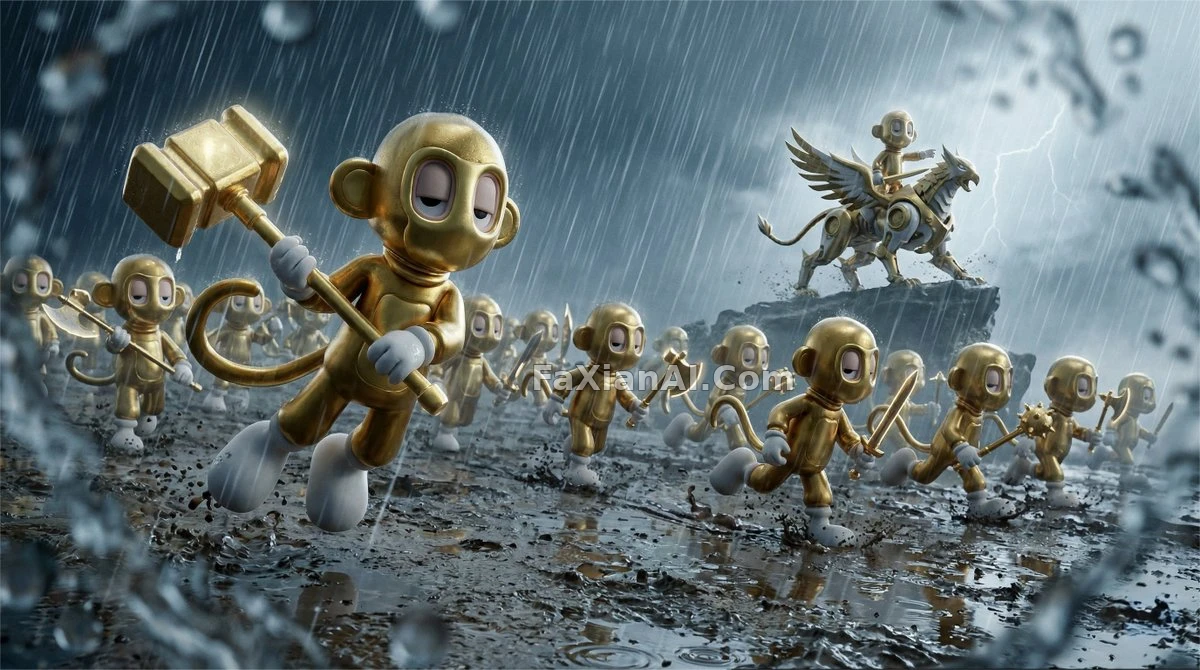
Cinematic macro toy photography: dozens of pea-sized individuals, all identical to the uploaded reference character, charging forward in a partially disrupted military formation through torrential rain, with a commander mounted on a fantasy steed leading them from deeper in the frame. Aspect ratio 16:9.
Identity integrity (CRITICAL): every individual must precisely preserve proportions, eye shape/spacing/stylization, silhouette, and material properties — no redesigning, no added features, no altered faces; every soldier is an identical instance of the same character.
Scene and motion structure: the army transitions from formation to full charge — the front rank moves first, the middle rank responds a few milliseconds later, and the back rank still partially holds formation, with the motion spreading through the army like a wave; each unit runs with controlled variation, stride timing and body angle differing slightly, no fully repeated poses, all motion directed forward; each unit carries an oversized medieval-style weapon, individually designed but visually unified, with a controlled subtle glow that never upstages the scene or obscures the character's identity.
Leader and mount (command layer): a commander appears deeper in the frame, positioned above the formation and off-center along a rule-of-thirds line, partially silhouetted in the rain and mist, clearly distinguished from the soldiers by scale and position; the mount's design logic must derive from the character's own materials and world-building language, not a literal clone or costume mimicry, but a subtle echo in form/texture/accents; the mount charges forward through the rain curtain, the leader's posture stable and controlled rather than exaggerated, conveying authority rather than chaos — the leader has already moved, and the army is catching up.
Foreground hero (impact anchor): the individual closest to the camera dominates the foreground, frozen mid-air in a dynamic leaping attack pose, limbs extended with directional force, the weapon leading the motion, serving as the visual entry point for the whole image.
Camera: an extremely low ground-level angle, nearly at ground height; 18-24mm close-range lens — the foreground character is enlarged by its proximity, the army extends diagonally into the depth of the frame, the leader visible in the mid/background layer, the horizon tilted slightly for instability, some units cropped at the frame's edges, giving the viewer a sense of being immersed within the charge.
Depth of field: extremely shallow — the foreground hero is sharp and crisp, nearby units slightly softened, the leader recognizable but partly blurred, the distant army dissolving into the rain and mist, avoiding full-frame sharpness.
Lighting (storm effects): hard, directional backlight/side light piercing the rain curtain, strong rim light carving out silhouettes, illuminated raindrops forming sharp streaks, deep shadows.