Home › Creative Ideas › A Solar System Made of Indian Street Food
A Solar System Made of Indian Street Food
Just dialing in the subsurface scattering on the tandoori roti planet took forever — the nebula particles were the easy part
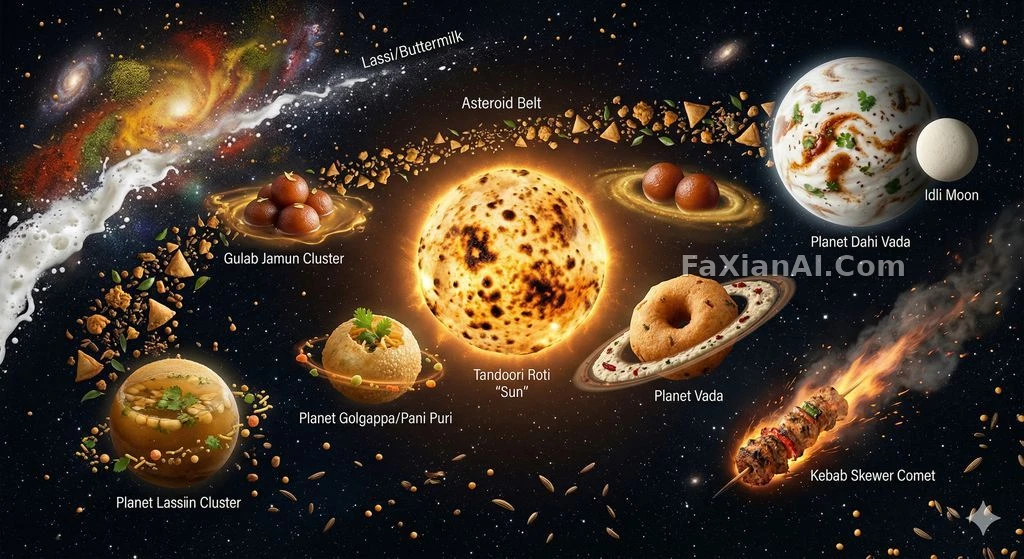
✍️ Each food has to map to a specific celestial form rather than being placed at random — donut-shaped for the vada, gas-giant for the yogurt surface. That form-matching rule is exactly what makes this set of images hold together.
📋 Prompt YAML Sectioned Style2630 characters
Create a space/cosmic-themed scene: an array of Indian street foods floating in deep space, together forming an entire delicious galaxy of planets, moons, and celestial bodies.
The structure of this food solar system:
At the center of the galaxy (standing in for the sun) is a giant round tandoori roti, glowing from within like a star, its surface marked with sunspot-like charred patches radiating a warm golden light outward.
The planet closest to the center, Planet 1, is a perfectly round golgappa/pani puri — its crisp shell glistening, spiced water visible through a crack in it, encircled by a miniature orbital ring of sev crumbs and chutney droplets.
Planet 2 is a round vada (medu vada), a donut-shaped celestial body wrapped in a ring system made of coconut chutney.
Planet 3 is a round plate of gulab jamuns, clustered together like a group of sweet brown asteroids, surrounded by a nebula condensed from syrup.
The asteroid belt is scattered with dozens of floating pieces of samosas, pakoras, and bhel forming a ring.
Planet 4 (a gas-giant type) is a giant round dahi vada — its white yogurt surface like a cloudy gas giant, marked with traces of tempered tadka, closely resembling the storm bands on Jupiter's surface.
A comet streaking across the whole scene is a skewer of grilled kebabs, trailing a tail of spice smoke and sparks.
A moon is a round idli, orbiting the dahi vada planet.
The nebula is formed from turmeric's yellow powder, chili's red powder, and cilantro's green powder mixing together in space, forming a vividly colored spice nebula.
Background setting: thousands of tiny points of light float in the deep black of space, actually mustard seeds and cumin seeds standing in as starlight; a distant galaxy of swirling masala powder is faintly visible far away; a clearly defined Milky Way formed from white lassi/buttermilk.
Lighting scheme: the tandoori roti acting as the "sun" provides the warm orange key light, illuminating the surrounding foods; each food radiates its own distinct glow — hot foods giving off warm light, cold foods (like lassi and curd-based items) glowing cool blue; overall the lighting follows a dramatic space-photography approach, highlights vivid and striking, shadows pure black and deep, with no atmospheric-scattering-style softening.
Style direction: a crossover between realistic food photography and NASA space photography. Every food item should show mouthwatering detail — crisp texture, rising steam, glossy sheen, fresh garnish — while floating in an authentic space environment, accompanied by realistic starlight and cosmic phenomena. Resolution 8K.